At the end of May 2026, Stanford Medicine hosted a webinar titled “Atypical Parkinsonian Disorders: Outreach, Access, and Education,” bringing together neurologists and other healthcare professionals to address the diagnosis and multidisciplinary management of progressive supranuclear palsy (PSP) and corticobasal degeneration (CBD)/corticobasal syndrome (CBS). This webinar was continuing medical education for physicians and other healthcare providers.
The medical education was co-hosted by Jocelyn Jiao, MD, and Niyatee Samudra, MD, who co-lead the CurePSP Center of Care at Stanford, and featured Sarah Kremen, MD; Lawren Vandevrede, MD, PhD; Erica Pitsch, DPT; Julia Nicholls, MA; and Amy Robb, LCSW.
Key takeaways from the webinar include:
Atypical Parkinsonian disorders are frequently mistaken for Parkinson’s disease, and recognizing them early changes how patients are counseled and cared for. PSP and CBD/CBS overlap clinically with Parkinson’s disease and other neurodegenerative conditions but follow distinct trajectories. They are rarely covered in medical training and are often misdiagnosed. Early, accurate recognition opens the door to appropriate counseling, supportive care, connection to advocacy organizations, and clinical trials.
A handful of “red flags” help distinguish PSP and CBD from Parkinson’s disease. Early, unexplained, and especially backward falls within the first one to two years; a vertical gaze palsy or slowed vertical (versus horizontal) eye movements; axial rigidity of the neck and trunk with retrocollis (a backward neck tilt, opposite the stooped posture of Parkinson’s); a poor or only brief response to levodopa; and strongly asymmetric cortical features such as limb apraxia, alien limb phenomenon, cortical myoclonus, or cortical sensory loss all point away from Parkinson’s disease and toward PSP or CBD.
PSP and CBD are “tauopathies,” and tau protein is the central treatment target. In PSP and CBD tau misfolds and clumps together. The location of these protein clumps determines a patient’s symptoms, while the total amount of tau mirrors the severity of the disease. Most disease-modifying research aims to reduce, clear, or block the spread of tau. Genetic testing is generally reserved for those with a strong family history, which is quite rare.
Biomarkers are improving but are not yet specific enough for routine diagnosis. Current tools — clinical exam, structural MRI (such as midbrain atrophy and the “hummingbird sign”), FDG-PET (fluorodeoxyglucose positron emission tomography scan), DAT scan, and plasma neurofilament light chain — are supportive rather than definitive. Promising emerging tools include skin-biopsy tau seed amplification assays, tau that can be detected CSF (cerebrospinal fluid) and blood sample, and 4R-selective tau PET tracers.
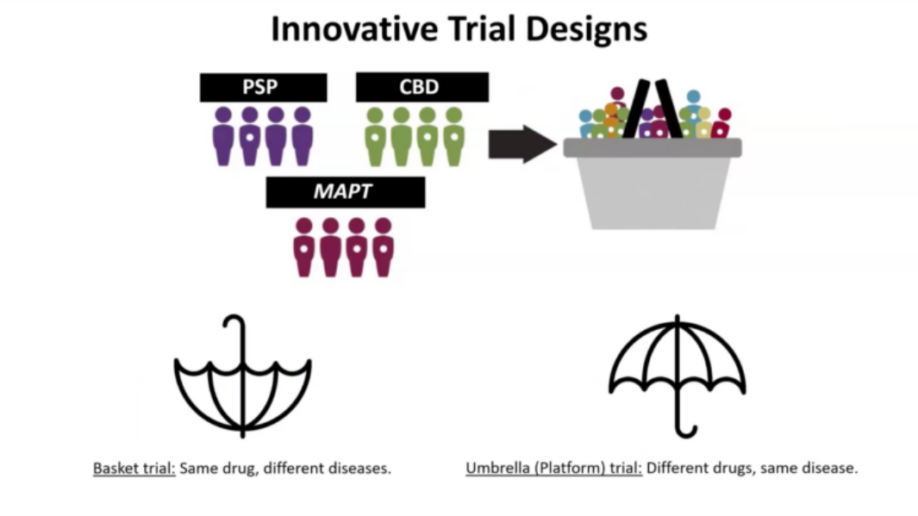
Clinical trials are expanding, including the first-ever Phase 3 trial in PSP. A growing number of disease-modifying trials, along with innovative platform and basket trial designs borrowed from oncology, are testing tau-targeting approaches, with several treatments now being studied in people. Basket clinical trial design tests a single drug across multiple different diseases.
Even without disease-modifying drugs, effective symptomatic and supportive care exists — and a multidisciplinary team is the difference-maker. Physical therapy (falls prevention, gait, balance, and exercise), speech-language pathology (speech, swallowing and aspiration risk, and communication tools), social work (early referral, advance care planning, and caregiver support), and palliative care all meaningfully improve quality of life. As the physical therapy session put it, exercise is the strongest “medicine” available.
Relevant resources include:
CurePSP — patient advocacy organization for PSP, CBD, and MSA, with vetted info and up-to-date clinical trial listings: psp.org
CurePSP Genetics Program — free, at-home genetic research study for people with PSP, CBD, or MSA: psp.org/genetics-program
Stanford CurePSP Center of Care — med.stanford.edu/neurology/divisions/memory/curepsp.html
Other CurePSP Centers of Care — psp.org/centers-of-care
Stanford Parkinson’s Community Outreach — for symptoms (constipation, incontinence, depression, swallowing issues, etc.) of PD and atypical parkinsonian disorders: med.stanford.edu/parkinsons/symptoms-PD.html
Brain Support Network PSP and CBD/CBS Support — separate support groups for those with a PSP or CBD/CBS diagnosis and for caregivers, open to those in Northern and Central California: brainsupportnetwork.org/support-group
Brain Donation Program — for PSP, CBD/CBS, MSA, FTD, PD and other diagnoses: brainsupportnetwork.org/brain-donation/
The Stanford Parkinson’s Community Outreach website has several relevant webpages for PD exercise, speech therapy, and fall prevention. These can benefit those with atypical parkinsonism conditions as well.
Now onto my notes,
Elizabeth
Atypical Parkinsonian Disorders: Outreach, Access, and Education
This was a Stanford Medicine CME Webinar
Speakers:
- Jocelyn Jiao, MD — co-host; movement disorders neurologist and co-lead, CurePSP Center of Care, Stanford University School of Medicine
- Niyatee Samudra, MD — co-host; cognitive/memory disorders neurologist and co-lead, CurePSP Center of Care, Stanford University School of Medicine
- Sarah Kremen, MD — Program Director for Behavioral Neurology and co-director, CurePSP Center of Care, Cedars-Sinai, Los Angeles
- Lawren Vandevrede, MD, PhD — cognitive behavioral neurologist and clinical trialist, UCSF Memory and Aging Center, San Francisco
- Erica Pitsch, DPT — physical therapist, UCSF
- Julia Nicholls, MA — speech-language pathologist (CSULA; Santa Monica College)
- Amy Robb, LCSW — clinical social worker, Stanford Neuroscience Clinic
Host: Stanford Medicine
Webinar Date: May 30, 2026
Summary by: Elizabeth Wong, Stanford Parkinson’s Community Outreach
Why Understanding Atypical Parkinsonian Disorders Matters
PSP and CBD/CBS overlap clinically with Parkinson’s disease and other neurodegenerative disorders but follow distinct trajectories, which makes early recognition important for patient care, counseling, and research.
The program was organized into three parts: clinical presentation and diagnostic challenges; biomarkers, neuroimaging, and clinical trials; and allied health and supportive care.
Cognitive and Behavioral Features (Dr. Sarah Kremen)
Atypical Parkinsonian syndromes overlap with the frontotemporal dementia spectrum and the primary progressive aphasias (progressive disorders that gradually erode language). PSP and CBD/CBS are both movement and cognitive-behavioral syndromes and should be considered together rather than separately.
Three main categories of cognitive features:
- Language: Word-finding difficulty on its own is common and very non-specific, but two distinct speech patterns are more telling. In the non-fluent (agrammatic) form of primary progressive aphasia, speech becomes effortful and broken and grammar falls away; this pattern, together with apraxia of speech (difficulty sequencing the movements needed to speak), points toward PSP or CBD/CBS. The logopenic form of primary progressive aphasia looks different — speech stays fluent and well-articulated, but the person has word-finding difficulty with word-finding pauses and trouble repeating long sentences; this pattern is more often seen in corticobasal syndrome caused by underlying Alzheimer’s pathology.
- Frontal executive dysfunction: This pattern brings trouble with concentration, working memory, problem-solving, planning, and sequencing. Frontal executive dysfunction also shows up as reduced letter fluency (naming as many words as possible that begin with a given letter) and a retrieval pattern of memory loss, in which a cue or hint helps the person recall something they could not retrieve on their own.
- Parietal dysfunction: These features are seen mostly in CBD/CBS. They include poor visual construction (assembling or copying shapes and figures), poor visual search (scanning to find a target among other items), apraxia (difficulty carrying out learned movements on command despite normal strength), left-right confusion, calculation problems, and neglect (failing to attend to one side of the body or space), along with features such as optic ataxia (trouble guiding the hand to a target by sight) and simultanagnosia (seeing only one object at a time rather than the whole scene).
Several bedside and cognitive tools help clarify the pattern. The MoCA® (Montreal Cognitive Assessment) is a brief screen, scored out of 30. It is most useful when its sections are read separately rather than as a single total: the naming and repetition items test language, the digit-span, attention, serial-subtraction, and abstraction items test frontal and executive function, and the trail-making, cube, and clock items test both frontal sequencing and parietal visual-spatial ability. The delayed-recall section is especially telling, since it separates a hippocampal, Alzheimer’s-type memory problem (where cues do not help) from a frontal-subcortical retrieval problem (where cues do help).
Other quick bedside tests are also useful such as copying hand postures (a fast check of left-hemisphere and parietal function); asking the patient to pantomime using a hammer or a saw (to detect apraxia); the Luria fist-edge-palm sequencing test (a dorsolateral-prefrontal task); and copying an alternating square-triangle pattern across the page, watching for perseveration (getting “stuck in set”), a frontal-executive sign. Simply listening to a patient’s speech is also informative; a recent paper co-authored with speech-language pathologists describes what to expect in PSP and CBS and how to manage it.
[Editor’s note: The paper referenced above is Rodriguez-Porcel F, et al. “Voice and Speech in Atypical Parkinsonian Disorders.” Movement Disorders Clinical Practice, 2026. https://doi.org/10.1002/mdc3.70515.]
Neuropsychological testing is valuable for clarifying the underlying pattern. A non-fluent aphasia or apraxia of speech points toward a tau-based disease such as PSP or CBD, while a logopenic aphasia or an amnestic (hippocampal) memory pattern points more toward Alzheimer’s-related CBS. Testing can also gauge how much depression, apathy, or anxiety is shaping the cognitive picture.
On treatment, distinguishing Alzheimer’s pathology matters: amyloid-confirmed cases (via amyloid PET or spinal fluid) may be candidates for newer anti-amyloid therapies such as lecanemab and donanemab. Standard cognitive medications (donepezil, rivastigmine, galantamine; memantine in moderate-to-severe stages) may be used.
Non-pharmacological supports include ophthalmology referral for prism glasses (double vision), speech therapy, and communication technologies and voice banking.
Behavioral features are often frontal (poor insight, disinhibition, impulsivity). SSRIs such as sertraline are commonly used, with non-pharmacological strategies first-line for agitation and antipsychotics used cautiously and chosen to minimize worsening Parkinsonism.
One medication is approved for pseudobulbar affect (inappropriate laughing or crying). Apathy is difficult to treat.
Movement Phenotypes and Clinical Red Flags (Dr. Jocelyn Jiao)
The movement features of PSP and CBD differ from those of Parkinson’s disease in several important ways.
PSP has an estimated prevalence of about 5–6 per 100,000 (roughly 4–5 times less common than Parkinson’s disease), with median survival around 6–7 years from symptom onset. The “hummingbird sign” on MRI (midbrain atrophy against a relatively preserved pons) is highly specific but not very sensitive — its absence does not rule out PSP. The most common phenotype, PSP-Richardson syndrome (about 40% of cases; named for neurologist J. Clifford Richardson, who first described PSP in the 1960s), features:
- Early postural instability with unexplained, often backward, falls in the first year or two.
- The “rocket sign” — springing up from a chair without caution and falling back into it.
- Supranuclear gaze palsy — difficulty with voluntary vertical eye movements (down-gaze affected first, causing trouble seeing the dinner plate or walking downstairs) while reflex eye movements remain intact; vertical saccades (the eyes’ quick jumps from one point to another) may be slowed relative to horizontal ones early on, and macro square-wave jerks (small involuntary eye movements that interrupt steady gaze) may break fixation.
- Axial rigidity of the neck and trunk and retrocollis (backward neck tilt) — the opposite of the stooped posture typical of Parkinson’s disease.
- Frontal-subcortical cognitive change (slowed processing, apathy, executive dysfunction).
- Speech and swallowing changes; aspiration pneumonia is the leading cause of death, underscoring the importance of early speech-language pathology involvement.
Up to then PSP phenotypes have been described, including PSP-Parkinsonism (resembles Parkinson’s at onset with a partial, transient levodopa response but earlier falls) and PSP with progressive gait freezing.
For CBD/CBS, CBD is a 4R tauopathy (a disease driven by the buildup of a particular form of the tau protein, described further below) usually confirmed at autopsy, while corticobasal syndrome (CBS) is the clinical picture, which can be caused by CBD, Alzheimer’s disease, PSP, or frontotemporal dementia. Features include profound asymmetry; dystonia (sustained muscle contractions that pull a body part into an abnormal posture — in about 40%, often a clenched hand or wrist that can progress to a fixed contracture, which early botulinum toxin injections can help prevent); cortical myoclonus (brief, shock-like muscle jerks, often triggered by touch or sound); limb apraxia (difficulty performing learned movements on command despite normal strength); alien limb phenomenon (the limb seems to act on its own); and cortical sensory loss (such as an inability to identify objects by touch or numbers traced on the palm), which standard sensory testing may miss.
Red flags include:
- Early, unexplained, backward falls within the first two years → suspect PSP.
- Axial-predominant Parkinsonism (neck, gait, trunk) rather than the limb-asymmetric pattern of Parkinson’s → PSP.
- Strongly asymmetric cortical features (apraxia, alien limb, cortical myoclonus, cortical sensory loss) plus Parkinsonism → CBS.
- Absent or only partial and short-lived levodopa benefit → argues against Parkinson’s disease.
- Vertical gaze palsy, or slowed vertical saccades relative to horizontal → characteristic of PSP.
- Prominent apathy, executive dysfunction, and progressive speech hesitancy → concern for PSP/CBD.
Even without an FDA-approved disease-modifying therapy, patients benefit enormously from a multidisciplinary team (physical therapy, speech-language pathology, occupational therapy, and nursing) and from connection to advocacy organizations such as CurePSP and to clinical trials
Neuroimaging and Biomarkers in 4R Tauopathies (Dr. Niyatee Samudra)
PSP and CBD are difficult to diagnose early because of varied motor and cognitive presentations and overlap with synucleinopathies (such as Parkinson’s disease and multiple system atrophy) and Alzheimer’s disease.
A biomarker is a measurable indicator of a biological process, condition, or treatment response.
Tau is a protein that helps stabilize microtubules (the internal scaffolding that keeps nerve cells in shape), encoded by the MAPT gene on chromosome 17q21, and exists as six isoforms (versions of the same protein) — three with three repeats (3R) and three with four repeats (4R). PSP and CBD predominantly accumulate 4R tau, in contrast to Alzheimer’s disease, which involves a mix of 3R and 4R.
Current diagnostic tools are supportive rather than definitive:
- Clinical presentation and examination.
- Structural MRI: midbrain atrophy / a midbrain-to-pons ratio below roughly 0.5–0.54 is highly specific for PSP-Richardson syndrome; CBD may show frontal and parietal (often asymmetric) atrophy.
- Amyloid and tau PET, mainly to identify whether Alzheimer’s co-pathology is present.
- FDG-PET, which shows patterns of hypometabolism — reduced brain-cell activity (frontal and subcortical regions, midbrain, thalamus, and basal ganglia in PSP; asymmetric frontoparietal regions in CBD).
- DAT scan (a brain image of the dopamine system), which confirms a dopamine deficit but cannot distinguish PSP or CBD from Parkinson’s disease; it is most useful to exclude non-neurodegenerative causes such as drug-induced Parkinsonism, and CBD may more often show a normal scan.
- Plasma neurofilament light chain, a nonspecific marker of disease severity.
Emerging biomarkers include:
- A skin-biopsy tau seed amplification assay (a lab test that detects tiny amounts of abnormal tau by prompting it to “seed” and multiply in the test tube). A recent study (Martínez-Valbuena et al.) reported high sensitivity in PSP and very high specificity, with a positive result in only one MSA case and none in Parkinson’s disease or healthy controls.
- CSF and plasma tau species, including microtubule-binding region (MTBR) tau ratios (such as MTBR-tau-275 and -282 relative to total tau), which distinguished CBD and PSP from controls with good performance; and plasma neuron-derived extracellular vesicles (tiny membrane-wrapped particles released by nerve cells) carrying tau species, which showed promise in distinguishing PSP from Parkinson’s disease even in early stages.
- 4R-selective tau PET tracers (such as PI-2620 and florzolotau), which show higher uptake in PSP and CBD — for example in the globus pallidus — than the Alzheimer’s-oriented tracers (such as flortaucipir).
Next steps include larger-scale validation and combining markers into multimodal diagnostic algorithms to improve specificity and enrich clinical trials with people who truly have PSP and CBD.
Clinical Trials in Tau-Based Diseases (Dr. Lawren Vandevrede)
These diseases do have treatments — symptomatic and supportive, both pharmacological and non-pharmacological — even though disease-modifying treatments are still lacking. Symptom-management resources are available from CurePSP and from the UCSF Memory and Aging Center.
On why tau is the target: tau correlates with disease stage and symptoms (the amount reflects severity and the location reflects symptoms), it appears to spread cell-to-cell in a prion-like fashion (self-propagating, the way the proteins in prion diseases spread) over roughly a decade, and MAPT mutations cause disease. Tau likely has multiple roles (microtubule stability, mitochondrial/energetic functions, maintaining DNA integrity in the nucleus, and regulating synaptic activity), so targeting it must be done carefully. The tau differs across diseases (3R versus 4R, and many post-translational modifications such as phosphorylation), which matters for drug design.
Targeting strategies span the “tau lifecycle”: antisense oligonucleotides (ASOs) to reduce tau production; blocking post-translational modifications (chemical changes the cell makes to the protein after building it, such as phosphorylation); inhibiting aggregation (keeping tau from clumping); enhancing clearance through the cell’s waste-disposal systems (the lysosome and proteasome); immunotherapies (antibodies) to limit cell-to-cell spread; and targeting downstream effects such as inflammation, oxidative damage, and synaptic loss.
Outcome measures include the PSP Rating Scale (a well-validated 100-point scale that changes about one point per year and was recently revised) and the patient-reported Cortical Basal ganglia Functional Scale (CBFS).
Trial designs adapted from oncology include umbrella/platform trials (multiple drugs tested one after another within one disease, sharing placebo groups — as in the HEALEY ALS Platform Trial) and basket trials (one drug tested across multiple diseases, such as PSP, CBD, and MAPT mutation carriers).
Notable trials:
- FNP-223 (targets an enzyme involved in a tau modification; active but not enrolling) in Richardson syndrome.
- An upcoming PSP platform trial in Richardson syndrome with three treatment arms; two have been announced — a tau vaccine and a lysosome-targeted clearance approach.
- The first Phase 3 trial in Richardson syndrome, using a tau ASO (NIO-752, Novartis), recruiting soon.
- A planned UCSF basket trial in primary tauopathies using the tau ASO NIO-752 (a Phase 1b/2a study, roughly 12 months with an open-label extension so all participants eventually receive the drug, 7–10 sites, including a tau-PET sub-study, with a goal of launching by the end of 2026). Referrals can be directed to the UCSF Memory and Aging Center; the trial is expected to be listed on ClinicalTrials.gov once it opens.
- A trial at Johns Hopkins studying pain associated with corticobasal syndrome using a stimulation approach.
CurePSP is a vetted, up-to-date source on available trials. Genetic testing is generally not done unless there is a strong family history, since MAPT mutations account for only a small fraction of cases.
Physical Therapy: Gait, Balance, and Functional Stability (Erica Pitsch, DPT)
Physical therapy centers on three strategies: prevent (especially falls), restore or improve (short-term gains, most effective in early and mid stages, by building cardiovascular capacity and strength — “every brain needs cardio”), and compensate (behavioral strategies, equipment, and environment, such as grab bars and reverse-brake rollator walkers). Stopping movement guarantees faster decline through atrophy, so exercise is the strongest available “medicine.”
For gait, external cues work better than micromanaging instructions like “heel-toe” — for example, taping the toe of the shoe and lifting the tape toward the ceiling, marching with exaggerated step length, or using an image of walking “with purpose and optimism.” Rhythmic auditory cueing with music or a metronome can produce short-term improvement; the approach is to calculate baseline cadence (steps per second converted to beats per minute), then set an aspirational target about 5–10% faster, with normal walking around 100 beats per minute.
For freezing of gait (which occurs in atypical Parkinsonism, especially PSP), low-harm strategies include lateral weight shifting, counting or a secondary task, auditory cues, and visual targets to step over (cracks in the pavement, a laser pointer, or objects attached to a walker).
On assistive devices, canes are discouraged (often carried rather than used, becoming a cognitive load or tripping hazard, and insufficient to prevent falls); a reverse-brake rollator walker is preferred, and for ataxia (unsteady, poorly coordinated movement), a heavier or weighted walker better resists sudden losses of balance. Family training on transporting the device and navigating the home matters, as do the difficult but important conversations about when to use a device or protective gear (such as bucket-hat- or baseball-cap-style protective headgear and knee pads), given that falls in PSP can be severe and self-awareness is often impaired.
For balance, useful approaches include perturbation and reactive training (deliberately nudging the person off balance — with a harness or hands-on guarding for safety — so they practice catching themselves), anticipatory postural control work (adjusting balance in advance of a planned movement), and multitasking circuits — for example, a wall of numbered sticky notes placed high to combine visual scanning, thoracic extension (straightening the upper back), and cognitive tasks. For sit-to-stand and backward loss of balance, an exaggerated forward weight shift paired with a stopwatch cue helps. The summary: prevent, compensate, recover; “exercise, exercise, exercise”; and set up the environment for safety.
Speech-Language Pathology (SLP) Approaches (Julia Nicholls, MA)
This talk opened with a demonstration of an AI voice clone.
Reasons to refer cover motor speech (dysarthria — slurred or imprecise speech from impaired muscle control, typically a hypokinetic or mixed-spastic type — and apraxia of speech), voice (hypophonia, meaning reduced loudness, and dysphonia, meaning a change in voice quality), swallowing (oral and pharyngeal dysphagia, meaning difficulty swallowing, with high aspiration risk and saliva management), and cognitive-linguistic symptoms (executive and memory dysfunction, aphasia including primary progressive aphasia, and pseudobulbar affect).
For speech and voice, programs such as SPEAK OUT!® (Parkinson Voice Project) and LSVT LOUD® aim to improve loudness, clarity, and intelligibility, with earlier intervention preserving more function. As speech declines, augmentative and alternative communication (AAC) ranges from low-tech (picture, word, and alphabet boards) to high-tech devices and apps (such as Lingraphica®), supported by care-partner training. Message banking (recording phrases in one’s own voice), voice banking (creating a personalized synthetic voice), and AI voice cloning (built from earlier recordings) should be done early. Ethical questions arise about ownership and use of a cloned voice after a patient dies.
For swallowing, care includes vigilance and evaluation (a modified barium swallow study, which is an X-ray video of swallowing, and FEES, a thin scope passed through the nose to watch swallowing), strategies to reduce aspiration and maintain hydration and nutrition, expiratory muscle strength training (EMST) to strengthen cough, diet-texture modification, and — when appropriate — considering a feeding tube earlier to preserve energy and nutrition, while recognizing it does not eliminate aspiration risk and raises quality-of-life and end-of-life considerations.
For cognitive-linguistic needs, helpful approaches include AI tools (such as Goblin Tools to break tasks into steps), external memory aids (planners, whiteboards, and simplified phones with assistive access), routines, environmental simplification, and care-partner training, along with script training and life-participation approaches for aphasia, and strategies for pseudobulbar affect.
The Role of Social Work (Amy Robb, LCSW)
Referring to social work early is important. Social work translates the diagnosis into daily life through a psychosocial assessment covering home environment, activities of daily living, finances and benefits (such as Medi-Cal or Medicaid), supports, and home safety, and connects families to resources, advance directives (healthcare and durable power of attorney, trusts, and conservatorship or fiduciary arrangements as needed), and case management (home health and equipment).
Three main messages for care partners:
- emphasize safety broadly (not only falls, wandering, and driving, but also whether the patient feels safe, since not feeling safe can drive agitation and irritability);
- establish routine early, for both patient and care partner; and
- give care partners permission to “pick their battles” and take the path of least resistance once safety is assured.
In later stages, goals-of-care and end-of-life conversations begin, with Stanford’s neuropalliative care team handling deeper discussions.
Suggested resources: Brain Support Network, CurePSP, Mission MSA, The AFTD (The Association for Frontotemporal Degeneration), Power for Parkinson’s, and the Parkinson’s Foundation.
Questions and Answers
Q: Is genetic testing useful for diagnosis or treatment, and what is the future of treatment, including genetic therapies? (submitted question)
A: Dr. Vandevrede explained that genetics are not routinely tested unless there is a strong family history, because MAPT mutations are relatively rare; when there is a family history, he strongly recommends testing, and he believes people with MAPT mutations should have access to clinical trials. He sees the future of treatment in targeting tau, while emphasizing that symptomatic treatments (for sleep, mood, motor symptoms, and voice) remain very important.
Dr. Samudra agreed that testing is less useful in sporadic PSP (cases with no family history, which is most of them) and more appropriate with a strong family history, and she highlighted the CurePSP Genetics Program (psp.org/genetics-program) on the research side.
Q: How can recent developments in neuroimaging and biomarkers transform the framework of clinical trials, and how important is multidisciplinary care? (submitted)
A: Dr. Samudra explained that biomarkers help in two ways: ruling out Alzheimer’s disease and synuclein-related diseases (where most biomarker advances have occurred), and serving as more specific “rule-ins” for PSP and CBD (plasma, CSF, or PET), which can enrich clinical trials with the right patients.
On multidisciplinary care, she described how she (a memory specialist) and Dr. Jiao (a movement specialist) collaborate at the CurePSP Center of Care because patients may present with cognitive-predominant or motor-predominant disease.
Dr. Jiao added that palliative care is a valuable extra layer of support that can begin at diagnosis and follow patients as the disease changes.
Q: Because these tauopathies cause both severe motor speech deficits and progressive cognitive and visual impairment, how do you adapt and customize AAC tools so they stay functional and accessible over time? (submitted, for Ms. Nicholls)
A: Ms. Nicholls works closely with occupational and physical therapy to maintain a patient’s ability to access a device; any remaining movement can drive a switch (for example, a head switch or one placed at the hand).
Communication-partner training is essential. Over time, devices may be simplified (fewer choices, changed layout, up-down or side-to-side), and patients may move from high-tech to partner-assisted low-tech options, where the partner offers choices and the patient indicates a selection with a yes/no nod or thumbs up/down.
Q: Should modulating axial tone be a priority in atypical Parkinsonian disorders, and is a walker still appropriate for those individuals? (submitted, for Dr. Pitsch)
A: Dr. Pitsch noted there is no clear, direct way to modify axial tone (the muscle tone in the neck and trunk). She does not let a single impairment drive the decision to use a walker; instead she steps back to the bigger picture — how often the person is falling, their quality of life, and whether fear of falling is causing self-limitation. If axial tone is causing pain, discomfort, or limited mobility, she addresses that, but she emphasized there is no direct cause-and-effect that would settle the walker decision on its own.
Q: How do you guide families to initiate early, proactive advance care planning while the person is still cognitively intact? (submitted, for Ms. Robb)
A: Ms. Robb said this is another reason to involve social work early. Patients who do not already have advance directives are often resistant, so she explains that the directives do not take effect until the person can no longer make their needs known, and she raises the topic gently and compassionately at each visit.
She emphasizes that the primary care partner should be involved in decision-making, rather than leaving those decisions to physicians or others the patient may not know.