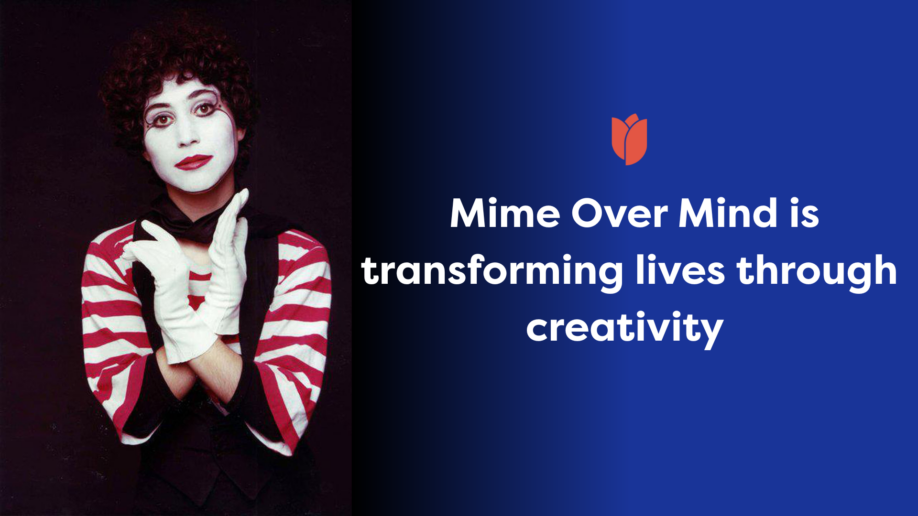
Mime over Mind is a program that applies classic mime training techniques to help people with Parkinson’s disease (PD) work through specific movement challenges, from picking up a glass of water to getting dressed. Developed by Barbara Salsberg Mathews, the program builds on the “Six Principles of PD Mime,” originally developed by mime artist Rob Mermin, and uses simple mime concepts to help retrain everyday movement.
The founder of Mime Over Mind is Barbara Salsberg Mathews, whose own journey with Parkinson’s began in 2020. Initially in disbelief about her diagnosis, Barbara eventually realized that Parkinson’s doesn’t define who she is.
Barbara studied mime in Paris, France, eventually founding and running a touring mime company. After her Parkinson’s diagnosis, she used mime techniques to teach herself to walk more normally and created a series of 12 short videos that demonstrate how the art of mime can do more.
Mime can help people living with Parkinson’s improve balance, gait and increase range and fluidity of movement. Therapeutic mime can help ‘wake-up’ your face, hands and body. It’s is fun, easy to learn, highly customizable, requires no cost or specialized equipment and focuses on everyday movements.
Barbara recommends you start by watching video 1. Introduction – Mime Over Mind. Then go through the remaining videos in chronological order. Wear comfortable clothes and shoes. Go through the exercises mindfully, at your own pace, and aim for your personal best.
Mime Helps Rewire the Brain
It’s possible that using mime to recreate movements for everyday activities opens new neural pathways in the brain to improve the quality of day-to-day life for people with Parkinson’s. Neuroplalsticity is the brain’s ability to change through experience, rewiring the brain to operate differently than how it did before.
On CBC Radio’s show, Ontario Today, Barbara described the ease of movement and state of ‘Flow’ using mime techniques helps her achieve, even with Parkinson’s.
Guest expert on the program, Dr. Jeff Puncher from University of Ottawa’s Faculty of Medicine suggested you can think of it like this. Barbara’s prefrontal cortex, which is the command centre of your brain, is basically saying ‘You can’t walk or you can’t do these exercises.’ But movement through mime creates new connections that respond with, ‘You know what? You can!’ and sends new signals to the muscles that allow her to move better.
The Six Principles of PD Mime
The Mime Over Mind program walks participants through six steps they can apply to a specific movement challenges:
- Awareness — noticing a movement problem as it happens (for example, a hand tilting while holding a glass of water)
- Observation — watching how the movement is currently being performed
- Analysis — breaking the movement down into its individual parts
- Visualize — picturing what the movement looks like when done normally
- Mime — practicing the corrected movement using the Three Mime Concepts below
- Real Life — mindfully applying the corrected movement in everyday situations
Three Mime Concepts
These foundational mime concepts can be applied to everyday movements like eating, getting dressed, and carrying objects:
- Freeze/Relax — Creating contrast between a relaxed hand and a “frozen,” held position, such as placing a hand flat against a wall and then releasing it. This contrast is part of what makes a mime illusion convincing, and the same idea can help with controlling and releasing movement in daily tasks.
- Space Substance — Shaping the hand to match the size and form of an object being held, such as a glass, without gripping too tightly.
- Point Fix — Keeping one part of the body anchored in place while the rest of the body moves around it, similar to how a hand stays fixed on a subway pole even as the body jerks forward and back.
Contact
Mime over Mind does classes and presentations in British Columbia, Canada, where the program is based. Visit Mime over Mind’s contact page for more information.