
In July 2026, the Michael J. Fox Foundation for Parkinson’s Research (MJFF) hosted a webinar titled “Parkinson’s or Something Else? Understanding Parkinsonisms,” to explore how Parkinson’s disease is distinguished from other conditions that cause similar symptoms. Parkinson’s disease and these related conditions are known collectively as parkinsonisms.
The panel featured Dr. Rebecca Williamson, a movement disorder specialist at Penn Medicine and director of its COPE (Comprehensive Outpatient Parkinsonism Evaluation) Center; Chris Humphrey, who was diagnosed with Parkinson’s disease in 2015 and with progressive supranuclear palsy (PSP) in 2022; and Harriet Adam, a care partner to her husband, Brian, who was diagnosed with Parkinson’s in 2013 and with multiple system atrophy (MSA) in 2022.
Parkinsonism is an umbrella term, not a specific diagnosis. Parkinsonism describes a group of symptoms — chiefly slowness, stiffness, and tremor — that can have many different causes. These include idiopathic (typical) Parkinson’s disease, which is the most common cause, as well as drug-induced parkinsonism, vascular parkinsonism, and the atypical (neurodegenerative) parkinsonisms that were the focus of this discussion.
The atypical parkinsonisms resemble Parkinson’s but carry distinctive “red flags.” Conditions such as progressive supranuclear palsy (PSP), multiple system atrophy (MSA), corticobasal degeneration (CBD), and dementia with Lewy bodies (DLB) share Parkinson’s core symptoms but add others — early falls and eye-movement problems in PSP; autonomic symptoms like blood-pressure and bladder changes in MSA; early dementia and visual hallucinations in DLB. Warning signs that show up in the first one to three years, along with a limited response to levodopa, and faster-than-expected progression, prompt doctors to look beyond Parkinson’s disease.
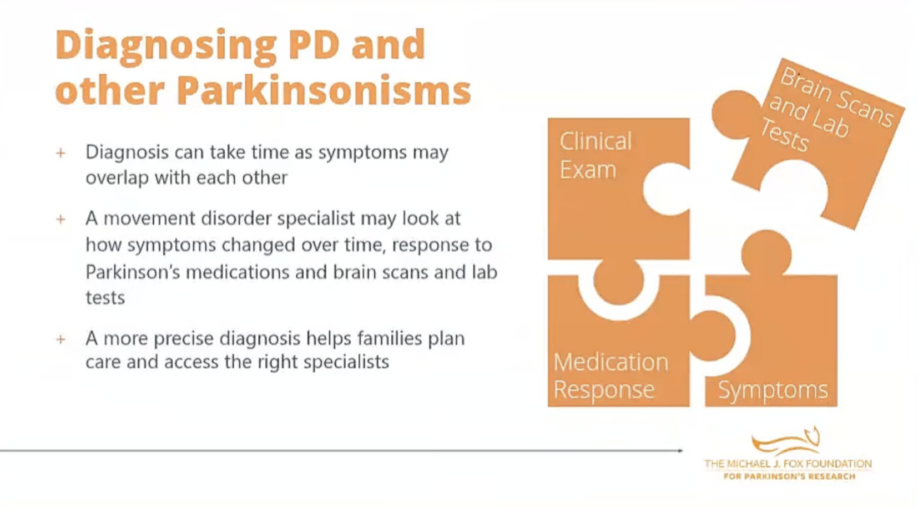
Reaching a specific diagnosis is often a gradual journey, and tests offer support but don’t replace the doctor’s judgment. Because early symptoms overlap so much, the diagnosis frequently becomes clear only as symptoms change over time. Tools such as a DAT scan, a brain MRI, and newer alpha-synuclein skin and spinal-fluid tests can help, but they work alongside — not instead of — a doctor’s examination and the person’s history.
A specific diagnosis matters even when the treatment stays similar. For both Chris and for Harriet’s husband Brian, knowing the exact condition did not greatly change their day-to-day medications, but it clarified what to expect, confirmed their sense that something was different, and — as both put it — brought home that knowledge is power. A specific diagnosis can also open the door to research studies and help with planning for the future.
Treatment centers on easing symptoms and staying active, supported by a whole care team. There are no medications yet that slow or cure these conditions, so care focuses on managing individual symptoms and keeping the body and mind active. Physical, occupational, and speech therapists, social workers, nutritionists, and palliative care specialists all play a part — and palliative care, which is about quality of life and can begin at diagnosis rather than only at the end of life, was singled out as especially valuable.
Care partners are indispensable members of the care team. Family members and care partners often notice subtle changes that neither the person nor the doctor would catch, and their observations, notes, and advocacy are invaluable during appointments. Staying socially connected — and finding support for the care partner as well — was described as essential to living well with these conditions.
Recording:
The recording of this webinar is posted on the MJFF YouTube channel
Resources:
Parkinson’s Precision Medicine Initiative (PPMI) — MJFF’s landmark study, recruiting volunteers with and without Parkinson’s to move research forward; participation is possible from home
Stanford Parkinson’s Community Outreach — for symptoms (constipation, incontinence, depression, swallowing issues, etc.) of PD and atypical parkinsonian disorders
For more information on this topic, Stanford Medicine hosted a webinar in May 2026 titled “Atypical Parkinsonian Disorders: Outreach, Access, and Education.” Read our notes on the Stanford PD Community blog
If you are lucky enough to live in Northern or Central California, join Brain Support Network’s atypical parkinsonism support group (PSP, CBD, MSA, and DLB)
Keep reading for detailed notes,
— Elizabeth
Parkinson’s or Something Else? Understanding Parkinsonisms
Panelists:
- Dr. Rebecca Williamson — movement disorder and cognitive specialist and researcher, Penn Medicine; director, COPE Center (Comprehensive Outpatient Parkinsonism Evaluation)
- Chris Humphrey — living with progressive supranuclear palsy (PSP); Cincinnati, Ohio; serves on a CurePSP advocacy advisory committee
- Harriet Adam — was care partner to husband who lived with multiple system atrophy (MSA); photographer; Parkinsonism advocate
Moderator: Rachel Dolhun, MD, Chief Medical Advisor, The Michael J. Fox Foundation
Webinar Host: Michael J. Fox Foundation for Parkinson’s Research
Webinar Date: July 16, 2026
Summary by: Elizabeth Wong, Stanford Parkinson’s Community Outreach
Parkinson’s disease and the other parkinsonisms are often discussed together because their symptoms overlap, the diagnosis frequently evolves over time, and the community is shared. Many people begin with a diagnosis of Parkinson’s that is later narrowed to a different parkinsonism. Two panelists spoke from lived experience. Chris Humphrey was diagnosed with Parkinson’s in 2015 and with PSP seven years later, in 2022. Harriet Adam cared for her husband, Brian, who was diagnosed with Parkinson’s in 2013 and with MSA in 2022.
What “Parkinsonism” Means
Parkinsonism is an umbrella term for a set of clinical signs that can have many causes. It has three main components: slowness (of any part of the body, from eye movements and blinking to facial expression, the arms, and walking); stiffness (which a person may report, or which a doctor may feel when moving the arms and legs); and tremor. In parkinsonism, the tremor is typically a resting tremor — most noticeable when the hand or leg is at rest rather than holding a position or completing an action. Importantly, parkinsonism describes a group of symptoms, not a single diagnosis.
The Main Categories of Parkinsonism
Idiopathic Parkinson’s disease is the “regular” Parkinson’s most people know, and it is the most common cause of parkinsonism. “Idiopathic” simply means the cause is not fully known.
Drug-induced parkinsonism can be caused by certain medications — especially some psychiatric (neuroleptic) medications that block dopamine, and some anti-nausea medications. It can look very much like Parkinson’s disease and often appears after taking these medications over long periods. It may sometimes affect both sides of the body rather than one, but it can be difficult to tell apart from Parkinson’s on exam alone; this is why doctors ask carefully about which medications a person takes and for how long, and whether adjusting them might ease symptoms.
Vascular parkinsonism results from damage to the brain’s blood vessels caused by the long-term effects of high blood pressure, cholesterol, or blood sugar — in effect, an accumulation of tiny strokes or scar tissue. When these changes affect areas of the brain also involved in Parkinson’s, the result can look like Parkinson’s disease. A brain MRI is usually used to identify it.
Atypical parkinsonisms — sometimes called “Parkinson-plus” syndromes — are the neurodegenerative conditions that cause changes in the brain over time and include parkinsonism plus additional symptoms. These were the main focus of the webinar.
The Atypical Parkinsonisms
There are classic features that help distinguish each one, however important to note that not every symptom occurs in every person, and that presentations vary:
Progressive supranuclear palsy (PSP) classically involves problems with eye movements — difficulty moving the eyes in all directions or slowness of the quick eye movements used to shift gaze — and early balance problems, with falls occurring earlier than would be expected in idiopathic Parkinson’s. In the office, a doctor may perform a “pull test,” gently pulling the person backward to see whether they can recover their balance.
Multiple system atrophy (MSA) involves parkinsonism and sometimes cerebellar (coordination) problems, along with prominent autonomic symptoms — those affecting the body’s automatic functions. These can include constipation, blood-pressure changes when changing position, urinary retention or other urinary problems, and problems with sweating or temperature regulation.
Corticobasal degeneration (CBD) can take several forms, but classic features include dystonia (an overactivation of muscles causing abnormal posturing of an arm or leg) and apraxia (a breakdown in the automatic, voluntary movements most people take for granted, such as walking or picking something up). Both PSP and CBD can also bring cognitive changes.
Dementia with Lewy bodies (DLB) involves parkinsonism together with cognitive symptoms and dementia that begin early — often within the same year the movement symptoms appear. It is frequently accompanied by visual hallucinations (seeing people or animals that are not there), cognitive fluctuations (changes in confusion or alertness through the day), and behavioral changes.
Recognizing Red Flags
One of the most challenging realities — for patients and doctors alike — is that the diagnosis often becomes clear only by watching how symptoms progress over time. At a first visit it may not be possible to say definitively whether a person has Parkinson’s or something else. A few specific findings serve as ‘red flags’ that lead a doctor to watch more closely or investigate further. These include early and significant balance problems or falls; prominent autonomic symptoms such as constipation, urinary problems, and blood-pressure changes; and specific changes in eye movements. As a general guide, when these appear in the first one to three years of symptoms, they prompt closer attention.
Rapid progression — for example, needing assistive devices within the first few years — combined with a limited response to medication also points toward an atypical parkinsonism. Because progression varies so much from person to person in idiopathic Parkinson’s, judging “faster than expected” is difficult, which is part of why better diagnostic tools are so needed.
Personal Journeys to Diagnosis
Chris Humphrey shared that she was still running half marathons when she was diagnosed with Parkinson’s in 2015 and remained very active. Over time she noticed the carbidopa-levodopa was not helping at all. At the same visit where she fell backward in her neurologist’s office, a quick eye examination led to a PSP diagnosis. She found it frightening — she had read that there was no treatment to slow the disease — and frustrating, because she had believed she had Parkinson’s all along and had stayed very active. [As the moderator noted, “no treatment” here means nothing yet to slow progression; many treatments exist to ease symptoms.]
Harriet Adam described her experience. Her husband, Brian was told in 2013 that he had a very mild case of Parkinson’s, and he kept working and running. But as his primary caregiver, she felt things did not seem mild and were progressing quickly, with constant medication changes in search of the right combination. Brian was considered for and underwent deep brain stimulation (DBS) — in hopes of relief, but it provided little benefit because ultimately he had MSA (but he was still diagnosed with PD at that time). After seeing another doctor and taking part in a multi-day study at the National Institutes of Health (NIH), the MSA diagnosis was given in early 2022, aligning with what Harriet and Brian had already come to suspect from their own research.
Both described the difficulty of living with uncertainty. Harriet observed that the uncertainty itself can start to feel like the only certainty, and that subtle changes — apparent to a caregiver even when they are not to others — made it hard to know whether a shift was a temporary “blip,” a medication effect, or a new normal. Chris recalled being focused on the medication that was not working while her neurologist was focused on her falling.
Diagnostic Tools
These diagnoses are still made primarily on the clinical exam and the person’s history. When there is uncertainty, several tests can help:
A DAT scan is a specialized nuclear-medicine brain scan. A substance is injected that binds to part of the brain’s dopamine transport system, and the scan looks for loss of cells in that area. It is most helpful in Parkinson’s disease but can be abnormal in the atypical parkinsonisms too — and can sometimes be normal, which adds confusion. A key point the moderator underscored: because both Parkinson’s and the atypical parkinsonisms involve the dopamine system, a DAT scan can help separate these from conditions that do not affect dopamine — such as drug-induced or vascular parkinsonism, or essential tremor — but it cannot separate Parkinson’s from the atypical parkinsonisms.
A brain MRI shows the structure of the brain. It can reveal vascular changes (small strokes or scar tissue) and a few signs that support certain atypical parkinsonism diagnoses, but it cannot by itself confirm any one of these conditions. Chris noted that her MRI made her think she did not have PSP, even though her doctor concluded otherwise — illustrating that imaging is one piece of a larger picture.
Newer biomarker tests look for specific proteins. Two tests — a skin test and a spinal-fluid test, the latter validated within the past couple of years — can help identify alpha-synuclein, one of the proteins involved in Parkinson’s disease, MSA, and dementia with Lewy bodies, and can support those diagnoses. There are not yet good tests for other proteins, such as tau and TDP-43, that underlie conditions like PSP and CBD, though research is ongoing.
Autonomic testing — for example, a tilt-table test and heart studies — can assess the blood-pressure and cardiac changes that are more prominent in MSA. Harriet noted that Brian’s NIH evaluation, which took place over five days under the care of a physician at NIH and included taking him off his medication, a tilt-table test, and a heart ultrasound, helped solidify his MSA diagnosis.
The recurring theme in this webinar was that tools can help but do not make the diagnosis on their own — they work together with the doctor’s expertise, the exam, the medical history, and how symptoms change over time.
Treatment and Support
Once an atypical parkinsonism is diagnosed, care leans heavily on a multidisciplinary team — physical and occupational therapists, speech therapists, palliative care specialists, social workers, and sometimes nutritionists — all providing support, equipment, and guidance. Medications can help with symptoms, but there are currently no medications that slow or cure these diseases. In Dr. Williamson’s experience, the patients who stay most physically and mentally active tend to do best, so she emphasizes activity, and at each visit works through specific symptoms — constipation, urinary problems, stiffness, pain — addressing them one by one.
Regarding levodopa response, Dr. Williamson explained that “responding” means noticing an improvement in symptoms after taking carbidopa-levodopa. Before concluding that someone is not responding, it is important to make sure they have reached a high enough dose without intolerable side effects, since some people cannot tolerate a dose high enough to help. The formulation — pill, inhaled, or infusion — does not really change that assessment, though different formulations may be better tolerated by different people. In Chris’s case, a lack of improvement even at a fairly high dose pointed toward a limited response.
Chris described her own supports: her husband, who is her caregiver, drives her everywhere and is always with her; she does a lot of walking and hiking; and will do periods of physical therapy and speech therapy that she continues to practice at home. She noted how she has adapted — she completed half marathons even after her diagnosis, with her last in May of 2025, which she did not finish, and she has slowed considerably but still walks daily (two and a half miles the morning of the webinar). The panel emphasized adapting exercise to stay safe, including seated exercises or holding onto a chair, and leaning on physical therapists to find safe options.
Palliative Care
Because Harriet found palliative care so helpful, Dr. Williamson addressed a common misconception: palliative care is often confused with hospice or end-of-life care, but that is only one part of it. Dr. Williamson described palliative care as care focused on quality of life — treating symptoms such as pain and constipation, often including non-medication approaches; planning for the future, including paperwork that is important for everyone to have; and supporting whatever helps a person live their best life. She said there is never a time that is too early to get involved, and the moderator added that palliative care is extra support available from diagnosis onward that also helps care partners and family, addressing emotional, planning-related, and spiritual needs.
The Care Partner
Harriet spoke about the care partner as the “invisible member” of the care team. She and Brian were in palliative care for nearly two years, which she credits as an invaluable extra resource; Brian called the team his “foxhole people.” For her, humor and connection were central — they laughed often, sometimes falling together, and staying social, she believes, prolonged Brian’s life and extended their time together. When getting out became harder, she brought people in, hosting gatherings at home and inviting friends to visit. She stressed that Brian did not hide behind the disease, and that being with others — including his rehab therapists — kept him connected.
Both Harriet and Chris highlighted how to advocate during appointments: tracking whether a symptom is new or ongoing, keeping a notebook or log (of things like blood pressure readings and medication timing), and bringing a second perspective. Harriet noted that when a doctor asked how Brian was doing, he would say he was doing great — while she could point to the falls and blood-pressure episodes he tended to overlook. Chris’s husband attends all her appointments and notices things she does not. As Dr. Williamson affirmed, input from family members and care partners is enormously valuable to doctors.
Research and Hope
Dr. Williamson pointed to real momentum in research, especially in diagnosis. The recent biomarker tests that detect alpha-synuclein are an important step toward telling these diseases apart and diagnosing them earlier. A major challenge is that some conditions are driven by other proteins — such as tau and TDP-43 — for which there are no tests yet, so a key research goal is finding those biomarkers and being able to use them earlier in the disease course. This matters because future treatments may only work if given early enough, before too much damage has occurred. Active research areas include imaging studies to identify biomarkers, tests looking for these proteins in spinal fluid and skin, and new medications aimed at specific symptoms or at removing harmful proteins from the brain to slow the disease — an approach that has seen some success in Alzheimer’s research. She acknowledged the work is challenging because these conditions are rare and overlap so much, but expressed real hope.
The moderator also encouraged participation in the Parkinson’s Precision Medicine Initiative (PPMI), which is recruiting volunteers from all backgrounds, both with and without Parkinson’s or atypical parkinsonism, because the more information researchers and the community has about what these diseases look like, the better providers can diagnose them. Participation can be done from home (https://www.ppmi-info.org/).
Questions and Answers Section
Q: My wife has Parkinson’s disease, but her doctors keep pointing us toward Parkinsonism. At the end of the day, what adjustments do we need to make to treatment?
A: Dr. Williamson explained that treatment often does not change much in terms of the medications available — the same medications, such as carbidopa-levodopa, are typically tried for the atypical parkinsonisms as for Parkinson’s disease. Having the specific diagnosis may add information and may change one’s outlook on prognosis, since these conditions can progress somewhat more quickly, but it does not necessarily change day-to-day management.
Q: If the treatment doesn’t change, why is it important to pursue a specific diagnosis?
A: As the panel discussed, a specific diagnosis brings knowledge — and, as Harriet put it, knowledge is power. It helps with understanding prognosis and knowing what to expect, and it can open the door to research trials for those who are interested.
Q: In Parkinson’s, we often hear about early signs like acting out dreams or loss of smell. Are those early symptoms similar for the parkinsonisms?
A: Dr. Williamson explained that these “prodromal” symptoms — which can occur years before other symptoms, such as REM sleep behavior disorder (acting out dreams), constipation, and hyposmia (reduced sense of smell) — are classically associated with the synuclein-related disorders: Parkinson’s disease, MSA, and dementia with Lewy bodies. The other atypical parkinsonisms can sometimes occur with these symptoms, but they are classically thought of in terms of the synuclein disorders.
Q: Are there genetic components to these parkinsonisms?
A: Dr. Williamson noted that, for the most part, these disorders are not genetically inherited — which is also true for idiopathic Parkinson’s disease. Researchers are learning more about genetics, and there are some genetic variants that increase risk, including some for the tau disorders PSP and CBD, but for the most part these conditions are not genetically linked.
Q: As a person living with Parkinson’s or a parkinsonism, or as a care partner, what questions are helpful to guide conversations with the doctor?
A: Harriet and Chris emphasized tracking symptoms and coming prepared. It helps to note whether a symptom is new (for example, something that happened once this week) or ongoing (happening all the time), and to keep a notebook — recording things like blood-pressure readings and medication timing — since the doctor only sees the person periodically. They also stressed the value of a care partner’s perspective: as a caregiver, listen to your gut, and be ready to fill in details the person may overlook.