In October 2026, the American Parkinson Disease Association (APDA) hosted a webinar titled “Pep in Your Step – Getting the Most out of Your Walking,” exploring why walking speed and intensity matter for people with Parkinson’s, how to measure walking intensity, and practical strategies for making walking brisker and safer. We recommend you read the full notes from this outstanding webinar. The presenter was Sara Zoeller, DPT, a physical therapist at Boston University’s Center for Neurorehabilitation, and the moderator was fellow physical therapist Teresa Baker, DPT. This session was part of the APDA’s ongoing “Let’s Keep Moving with APDA” program.
Key takeaways from the webinar include:
Walking practice is one of the best ways to improve walking. Walking is one of the highest-priority motor concerns for people with Parkinson’s, even early after diagnosis. Walking practice (also called walking training or gait training) means walking with the specific goal of improving your walking, rather than just being active. It can be done on a treadmill, over ground, or with walking poles, and often uses the strategies such as focusing on longer steps and arm swing, walking to a beat, or alternating faster and slower intervals. Walking training can improve step length, speed, balance, endurance, and overall mobility. Physical therapists recommend at least 20 minutes of walking training, 3 to 5 times a week, when the goal is to improve walking.
Brisk walking can double as aerobic exercise. When walking is fast enough to reach a moderate intensity, it counts toward the recommended aerobic training of at least 3 times a week for 30 to 40 minutes. Aerobic exercise may offer additional benefits, including potential disease-modifying effects. Not everyone can combine the two, and doing what you can is what matters.
Use more than one way to measure intensity. Heart rate is useful, but Parkinson’s can blunt the heart rate response, making it less reliable for some people. The rate of perceived exertion (“How hard am I working?”) and the talk test — you can talk but not sing — are simple alternatives.
Steps per minute is a practical guide to brisk walking. Total daily steps show overall activity, but cadence (steps per minute) shows how brisk the walking is. About 100 to 120 steps per minute is a good average target, adjusted to the individual. To check, count steps on one leg for 15 seconds and multiply by 8.
Cueing strategies can help you pick up the pace. Different strategies work for different people: focusing attention on long steps and arm swing at set check-in points, walking to a metronome or music at your target beat, or matching the pace of a walking partner.
Intervals, treadmills, and a smart setup support safe, faster walking. Alternating fast and comfortable intervals builds tolerance, and a treadmill holds a steady pace. Supportive shoes, even surfaces, fewer distractions, and possibly walking poles also help — ideally with guidance from a physical therapist.
Resources:
A recording of this webinar is available through the APDA YouTube channel
The APDA National Rehabilitation Resource Center for Parkinson’s Disease, based at Boston University’s Center for Neurorehabilitation — offers an exercise helpline (888-606-1688 or rehab@bu.edu) staffed by licensed physical therapists.
For a related Stanford Parkinson’s Community blog post, check out the notes from the earlier “Let’s Keep Moving” episode on auditory cueing, “Walk to the Beat! How Music Can Help Your Walking”
Watch past episodes of the Let’s Keep Moving series on the APDA YouTube channel playlist
Keep reading for detailed notes,
— Elizabeth
“Pep in Your Step – Getting the Most out of Your Walking”
Speaker: Sara Zoeller, PT, DPT, physical therapist, Center for Neurorehabilitation, Boston University (bu.edu/neurorehab)
Moderator: Teresa Baker, PT, DPT, physical therapist, Center for Neurorehabilitation, Boston University
Webinar Host: American Parkinson Disease Association (apdaparkinson.org)
Webinar Date: October 6, 2026
Summary by: Elizabeth Wong, Stanford Parkinson’s Community Outreach
A walking program should be individualized. Some people may not benefit from a walking program because of other health conditions, so anyone starting or advancing a program is encouraged to work with their medical team and physical therapist and to stay within their own limits.
Why Walking Matters in Parkinson’s
Walking is a top priority for people with Parkinson’s. Dr. Zoeller shared results from a 2021 study (https://doi.org/10.3233/JPD-202346) in which people across the range of PD ranked their motor symptom priorities: after tremor, the combination of walking, movement, balance, and falls was the second-highest motor priority. A 2025 study (https://doi.org/10.1002/mdc3.14321) of both motor and non-motor symptoms found that altered gait is one of the most bothersome symptoms even early after diagnosis.
Several Parkinson’s symptoms affect walking:
- Bradykinesia (slowness of movement) — even when a person starts walking quickly or with long steps, the pace can slow down or the steps can shorten without the person noticing.
- Postural control (balance)
- Stiffness
Walking practice (also called walking training or gait training) means walking with the specific goal of improving how you walk, rather than simply being active. This is one of the best ways for people with PD to improve their walking. It can be done on a treadmill, over ground, or with walking poles. Walking training can improve step length, walking speed, balance, endurance, motor symptoms (such as the slowness and stiffness a neurologist tests for), and overall mobility.
Faster walking can also count as aerobic exercise. Aerobic training can take many forms, such as cycling, an elliptical machine, swimming, or Zumba, as long as it raises the heart rate; walking counts when it is fast enough to reach the right intensity. Aerobic training shares many of the benefits of walking training and may have additional benefits, including potential disease-modifying effects and effects on some non-motor symptoms of PD.
Exercise Recommendations
There are several “buckets” of exercise that physical therapists recommend for people with Parkinson’s:
- Aerobic training — at least 3 times a week for 30 to 40 minutes, which can combine walking with other activities.
- Balance and agility training.
- Strength training and flexibility exercise.
- Walking training (also called gait training), when the goal is to improve walking — at least 20 minutes, 3 to 5 times a week, working specifically on walking.
Combining aerobic and walking training can save time, but this may not be possible for everyone. Some people face barriers that limit how long or how fast they can walk, so the two may need to stay separate. She also acknowledged that not everyone meets these recommendations, and encouraged people to do what they can across the different buckets.
How to Tell If You’re Walking Briskly
Dr. Zoeller described several ways to measure whether you are walking at a moderate intensity.
Heart rate can be checked with a wearable device such as a watch, a separate heart rate monitor, or by checking your pulse at the neck or wrist with a timer. Some people with PD have chronotropic incompetence, meaning their heart rate does not rise as much with exertion and does not reach the same maximum as others their age. If your heart rate does not reach the preset zones on your watch or treadmill, Parkinson’s may be affecting your heart rate response, and heart rate is then less reliable. A physical therapist or exercise professional can help you find the right zones for you.
Rate of perceived exertion (RPE) answers the question “How hard am I working?” For moderate intensity, the target is around the “somewhat hard” to “hard” level; high intensity is “very hard.” Other quick checks include:
- The talk test — you can talk but not sing, or you are talking but getting a little out of breath.
- Sweating — although this varies with climate and between people, so it is not the most reliable measure.
Dr. Zoeller suggested getting in the habit of asking yourself how hard you are working every so often during a walk.
Walking speed is useful for setting individual goals, for example on a treadmill or from a device that gives summary feedback after a workout, though it is harder to give one speed recommendation that applies to everyone.
Total steps per day can be tracked by most phones and many activity monitors. Total steps can be motivating, show your overall activity level, and help with goal setting; Dr. Zoeller likes to compare activity over time in the clinic, such as the past 6 months versus the 6 months before. However, these devices may not be perfectly accurate for people with PD, especially wrist-worn trackers when arm swing is reduced. Total steps also do not show how brisk the walking was — 5,000 steps puttering around the house counts the same as 5,000 steps on a fast walk.
Cadence (steps per minute) measures stepping speed, but not step length. Dr. Zoeller said a cadence of around 100 steps per minute is often used as a cutoff for a moderate pace, with 100 to 120 a good average target for brisk walking. This should be individualized, since 100 may be too fast for some people. Ways to check your cadence:
- Watch a timer for 15 seconds and count your steps on one leg, then multiply by 8 to get steps per minute. A count of about 12 to 15 puts you roughly in the 100 to 120 range.
- Use an activity tracker or app. Dr. Zoeller noted that on some watches, such as Garmin and Apple Watch, the run feature shows real-time cadence while the walk feature does not.
- Divide the steps from a walk by the minutes walked for an average.
Strategies to Pick Up the Pace
Dr. Zoeller noted that different strategies work for different people, and encouraged trying several to see what works.
Directing your attention to your walking: In Parkinson’s, movements tend to be bigger and faster when you are thinking about them than when you are distracted. You might start a walk at a good pace, then notice after 5 minutes that you are shuffling or slowing down; refocusing on your walking can help you pick up the pace again. Some possible strategies:
- Pair this with cues you may have learned in physical therapy, such as taking long steps or swinging your arms quickly. Getting your arms and legs in rhythm can help.
- Set check-in points to trigger your cues, such as every 2 minutes on a treadmill, at the end of each block, or each time you cross a street or make a turn.
The benefit is that this works anywhere, anytime; the drawback is that constantly refocusing can feel tiring.
Auditory cueing uses a metronome or music with a beat at your target cadence, often 100 to 120 beats per minute, though it can be higher or lower. Dr. Zoeller said there is a lot of evidence that auditory cueing is effective for people with PD. In her description, the rhythm may help bypass the basal ganglia circuitry (a group of brain structures involved in movement that are affected by PD) to help a person get into a better, faster rhythm. It can also be enjoyable, and ongoing research suggests it may require less attention than self-cueing. Some possible strategies:
- Start at your normal walking pace, then try raising the beat by 5 to 10% when walking over ground.
- Use an inexpensive battery-operated metronome, a free metronome app, or the metronome that appears when you search “metronome” on Google, with or without headphones.
- Make or find a playlist at your target beats per minute. Dr. Zoeller suggested AI tools can help build a playlist at a certain beats per minute in a style you like.
- For short distances, try mental singing — humming a quick song in your head, such as when crossing a field to get to a grandchild’s soccer game.
- Specialized devices (such as Movive) are emerging that use sensors to match music to your rhythm.
Partner pacing: Walking with a partner who walks at your speed or a little faster can serve as a natural cue, similar to a dance partner, and can be enjoyable socially. Communication is key — let your partner know you want them to set a faster pace, and agree on a way to say when it is too fast. If distraction slows you down or affects your balance, you might chat during the warm-up and cool-down and talk less during the brisk portion.
Interval training alternates a fast interval with a comfortable or slow recovery interval. Dr. Zoeller noted there is less scientific evidence for interval walking in PD than for interval training on a bicycle or in strength training, but clinicians use it to add fast walking and build walking tolerance. The timer naturally brings your attention back to your walking. Some possible strategies:
- One example is 1 minute fast and 2 minutes comfortable, but there is no known ideal; adjust the timing to what works for you.
- Change speed safely. Slowing down can be challenging for people with festination (involuntary quickening of steps with forward momentum), and speeding up can lead to catching a foot, so ease in and out of transitions.
- Apps can give a chime or beep to signal speed changes, so you do not have to watch the clock.
Treadmill walking keeps you at a constant speed, so your pace will not drift down after 5 minutes unless you turn it down, and it gives good control over speeding up. Visual cues can help you take long steps and stay toward the front of the treadmill, and the handrails provide support — some people can walk faster on a treadmill than over ground. A treadmill is not for everyone: it is important to feel safe getting on, getting off, and changing speeds, and a physical therapist can help. Access to a gym or home equipment can also be a barrier.
Environmental Considerations
- Assistive devices — even if you do not usually use a cane or walker, one or two walking poles may provide extra stability for brisk walking. Nordic walking uses two poles with more arm movement and pushing off the ground, adding aerobic intensity and balance support. Work with a physical therapist if balance or fear of falling is affecting your walking program.
- Footwear — wear supportive, snug, well-fitting shoes.
- Surfaces — avoid uneven surfaces such as bricks when possible. An even track, sidewalk, or park path reduces tripping hazards and the need to slow down.
- Distraction — walking can change or slow down with distraction, sometimes even early in PD, so minimize distractions such as phone calls during a brisk walk.
- Frequent stops — pets that stop to sniff and chatty neighbors can interrupt a brisk walk. Be intentional about where and with whom you walk when your goal is a faster walk.
Key Take-Home Points
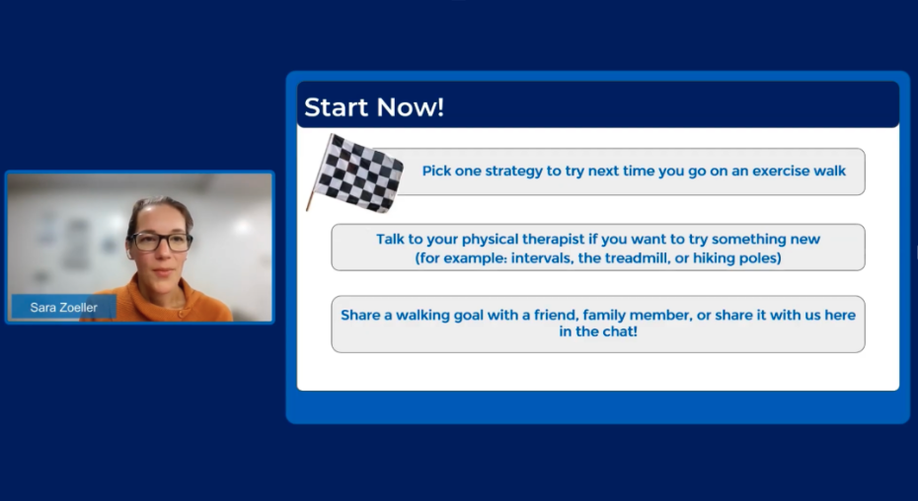
- Pick a time in the next week to try one of these strategies, and try another if it does not work.
- Talk with a physical therapist about trying something new, such as treadmill walking or walking poles.
- Share your walking goal with a family member or friend who can support you.
Questions and Answers Section
Q: Is it better to walk 30 minutes at once or break it up into two 15-minute walks?
A: The general recommendation is that if you are comfortable walking at least 10 minutes, you can break up your walking in 10-minute increments, since bouts of at least 10 minutes allow time for the cardiovascular system to warm up and give more of an aerobic response. Whether to walk all at once or in two 15-minute blocks depends on what works for you. If fatigue causes you to slow down, catch your foot more, or feel tired legs by the end of a walk, breaking it up may let you start fresh for the second walk.
Knowing yourself matters — for some people, a planned second walk never happens — and that shorter daylight hours in some parts of the country can also affect timing.
Q: If someone is afraid of falling, would a cane or a walker be better?
A: Fear of falling warrants a personalized approach, so this question is best directed to the person’s own physical therapist.
Q: Can Nordic walking fit into this routine, and could walking poles help with arm swing?
A: Walking poles can be hit or miss. They can provide stability and balance support, but coordination can be challenging, so it is important to use them rhythmically and make sure they do not become a tripping hazard. Recommended trying them with a physical therapist and not giving up after one try, since using walking poles is a skill that takes practice. A variety of assistive devices may help with this type of walking program, but there is no blanket recommendation.
On arm swing, the answer is individual. Walking poles act as an external cue that makes you more conscious of bringing your arms forward, which may increase arm movement in the moment, though people with very limited arm swing may move the poles only a small amount. In her view, it is not known whether using poles carries over to arm swing after the poles are put down.
Q: If the heart rate does not go up but the person is walking briskly, is the brisk walking still helpful?
A: The speakers said they believe it is. The walking practice itself is valuable, and an unchanged heart rate does not mean you are not getting blood flow to your muscles and brain. Dr. Baker added that the RPE scale is another way to gauge intensity.
Q: Are the hand-grip heart rate sensors on machines such as ellipticals reliable?
A: It depends on you and the machine. In the clinic, these sensors are sometimes spot on and sometimes way off compared with other monitors or a manual pulse check, and sweat and how well the sensor picks up your pulse can interfere. Recommend cross-checking by taking your pulse at your wrist right after your workout; if you use your own machine at home, you can get a sense of whether it is consistent day to day. A reading that jumps around a lot — such as 90 beats per minute one minute and 130 the next at the same speed — is usually a sign it is not accurate.
Q: How do you find the beats per minute of a song?
A: Searching Google for a song’s beats per minute works for most songs. AI tools can also list the beats per minute for songs in a playlist, some music apps can show it, and pre-made playlists in ranges such as 100 to 110 or 120 to 130 beats per minute are available. It usually takes some searching, since beats per minute are not listed with the song credits.
The website https://jog.fm/ lists many songs by beats per minute. A song’s beat doesn’t have to match your steps per minute exactly. A song within about 5 to 10 beats per minute of your cadence generally works well.
Q: What are the pros and cons of walking while experiencing dyskinesia?
A: This depends on how dyskinesia affects you; some people walk well with dyskinesia. Dyskinesia often occurs during “on” time, when medication is working well, and timing walks to your “on” time is another strategy, since you can usually generate faster, longer steps with less shuffling. If dyskinesia is bothersome, you might wait until the peak passes while the medication is still working.
Problems that can occur with dyskinesia include a foot turning in, feet crossing over each other, and excessive head movement that can throw off balance or be uncomfortable. If dyskinesia affects your balance or raises the risk of catching a foot or rolling an ankle, recommend working with your neurologist to manage it and timing walks for medication benefit with less dyskinesia.
Comment: Viewers shared challenges such as freezing, knee pain, leg weakness that prevents walking, and a family member with PD whose reduced cognitive capacity requires caregiver support.
A: These challenges can strongly affect a walking program and deserve individualized attention from a physical therapist. Many people are doing their best to stay active despite these challenges.
APDA Exercise Helpline is open to everyone. The next Let’s Keep Moving episode, in December, will cover how to use your home as your exercise environment.