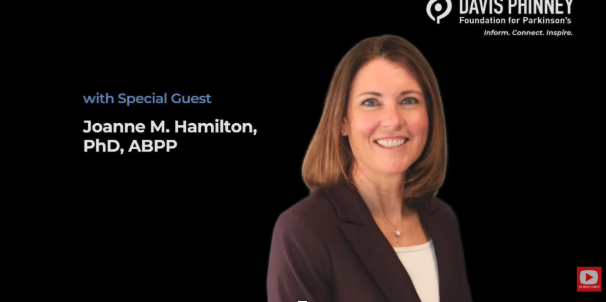
The Davis Phinney Foundation for Parkinson’s (DPF) hosts a monthly Care Partner Meetup and, for October 2026, the topic was, “Understanding the Hidden Side of Parkinson’s.” The meetup featured Joanne Hamilton, PhD, a clinical neuropsychologist in San Diego. Connie Carpenter Phinney, DPF board member and care partner to DPF founder Davis Phinney, led the conversation alongside DPF Ambassadors and care partners Pat Donahoo, whose wife Cidney lives with Parkinson’s, and Gail Gitin, who was a care partner to her late husband, Gene. A member of one of our local Parkinson’s caregiver support groups recommended the October meetup to us, and we are glad she did.
The conversation focused on the non-motor symptoms of Parkinson’s — changes in thinking, mood, behavior, and the body’s automatic functions that are often invisible to others — and on how care partners can understand these symptoms, communicate about them, and protect their own well-being. Questions and comments from attendees in the chat were addressed throughout the discussion.
Key takeaways from the meetup include:
Parkinson’s is far more than a movement disorder. Dr. Hamilton explained that the brain circuits involved in movement are interconnected with circuits involved in thinking, mood, digestion, and pain. When one system begins to break down, others often do as well. In her words, what you are seeing in the movement “is happening with the mood, with the thinking, with the gut, with the pain.” The visible motor symptoms are only the tip of the iceberg.
“Freezing” can affect speech and thinking, not just walking. Freezing of gait — when the feet will not move forward despite the intention to walk — has parallels in speech, which may become halting or stutter-like. Dr. Hamilton noted that most people with Parkinson’s she sees describe word-finding problems, often even before diagnosis. When medication is wearing off, slowed thinking can mirror slowed movement.
Non-motor changes often begin years before diagnosis, so give yourself grace. Anxiety, irritability, apathy, and difficulty finishing projects can appear long before motor symptoms. Many care partners later look back and realize when the disease actually began, which can bring grief and guilt. Dr. Hamilton encouraged care partners to allow themselves to grieve and to work on releasing guilt over changes that happened before anyone knew the cause.
Caring for yourself is essential, not optional. Dr. Hamilton put it bluntly: “You’re no good to anyone when you’re dead.” She strongly encouraged care partners to find a therapist — even one visit a month, possibly by telehealth — and to carve out time for their own well-being. She also advised setting realistic expectations about what the person with Parkinson’s can still do.
Helping others can help you, too. Pat and Gail described how volunteering and supporting other care partners have given them purpose. In Dr. Hamilton’s view, there is strong evidence that people who volunteer even 15 to 30 minutes a month have a better mood than those who are solely inward-focused.
Anxiety and panic in Parkinson’s can be biological, not purely emotional. PD affects the autonomic nervous system, which controls heart rate, blood pressure, digestion, and other automatic functions. Dr. Hamilton explained that when this system is dysregulated, a person with Parkinson’s may feel as though they are in a near-constant panic attack. She encouraged care partners to discuss persistent anxiety with the neurologist, as medications may help.
Track what is disruptive or dangerous, and talk openly about all symptoms. Dr. Hamilton recommended tracking falls, sleep disorders, new visual hallucinations, and episodes of lightheadedness or fainting on standing — and letting everyday nuisances go. She encouraged families to tell providers about symptoms that can feel stigmatizing, such as hallucinations, urinary problems, and intimacy concerns, because “no one knows until you tell them.”
A neuropsychological evaluation can explain and validate what care partners see. Dr. Hamilton explained that a person with Parkinson’s may lack insight into their own cognitive changes, and that this is brain-driven, not denial or stubbornness. A qualified neuropsychologist, ideally connected with a movement disorders program, can help clarify what is happening. When important decisions need to be made, she suggested presenting them when the person’s medication is working best, in simple, yes-or-no terms.
Resources
You can watch a recording of the October 2026 meetup on the Davis Phinney Foundation YouTube Channel
Sign up for future monthly meetups with Connie Carpenter Phinney
For more information on non-motor symptoms of PD and caregiving, visit the Stanford Parkinson’s Community Outreach website:
Coping with PD Symptoms What Caregivers Can Do
Discuss these issues further at a caregiver support group meeting near you. If you live in Northern and Central California, check out these caregiver support groups:
Caregiver Support Groups for PD and Related Disorders in Northern and Central California
Now onto my notes,
— Elizabeth
Care Partner Meetup: Understanding the Hidden Side of Parkinson’s
Speaker: Joanne Hamilton, PhD, ABPP-CN, clinical neuropsychologist, San Diego, California
Panelists:
Connie Carpenter Phinney, board member, Davis Phinney Foundation, and care partner to Davis Phinney
Pat Donahoo, Davis Phinney Foundation Ambassador and care partner, Las Vegas, NV
Gail Gitin, Davis Phinney Foundation Ambassador and care partner, Boulder, CO
Meetup Host: Davis Phinney Foundation for Parkinson’s (davisphinneyfoundation.org)/ Care Partner Monthly Meetup
Meetup Date: October 20, 2026
Summary by: Elizabeth Wong, Stanford Parkinson’s Community Outreach
Connie Carpenter Phinney leads the monthly Care Partner Meetup with DPF Ambassadors Pat Donahoo and Gail Gitin. She noted that friends and family often see a person with Parkinson’s at their best — tremor controlled, cheerful in public — while care partners see facial masking and other changes at home.
What Is Neuropsychology?
Dr. Hamilton described neuropsychology as the marriage of neurology and psychology. Most neuropsychologists are clinical psychologists by degree, with additional training in neuroanatomy, neurophysiology, and neuropharmacology.
The role of a neuropsychologist is to understand the symptoms that cannot be seen. Every neurological condition affects not only movement but also thinking and emotion, because the parts of the brain responsible for tremor or facial masking are connected through circuits to many other brain regions.
The Tip of the Iceberg
The visible symptoms of Parkinson’s disease are “the veritable tip of the iceberg.” Dr. Hamilton noted that tremor and freezing of gait are actually among the symptoms that clinicians manage fairly well. What she explains to families is that what they see happening in movement is also happening with mood, thinking, the gut, and pain. If a person is freezing physically, their thinking brain is freezing as well.
Freezing of Gait and Halting Speech
Dr. Hamilton described two broad forms of Parkinson’s:
- Tremor-predominant Parkinson’s, in which tremor is often the first and most obvious sign.
- A form centered on the midline of the body, which comes with significant postural instability, frequent falls, and freezing of gait.
In freezing of gait, a person stands and begins to move forward, their weight shifts, but their legs do not follow. The feet may stutter-step while the person consciously tries to override the freeze. Freezing tends to be activity-specific and is often triggered by visual cues such as patterned floor tiles or a door threshold. Dr. Hamilton believes this relates to how the visual and motor parts of the brain connect.
Dr. Hamilton recalled a patient with advanced motor symptoms but no cognitive changes who, at the end of his evaluation, asked her to hold the door open — then launched himself out of his chair and sprinted through the doorway with his walking sticks, knowing that if he hesitated, he would freeze. Physical therapists sometimes train people to “leap” past a freeze to get their legs moving.
Freezing and halting in speech and thinking. Speech may become halting, almost like a stutter, with changes in cadence. Dr. Hamilton noted that the vast majority of people with Parkinson’s she sees describe word-finding problems, often even before diagnosis — for example, using pronouns such as it, that, or this because the intended word will not come.
When a person is coming off their medication, care partners may notice slowed thinking alongside slowed movement; what families sometimes call “a bad day” or “a confused period” may reflect medication wearing off.
Connie added that halting speech can make a person lose their train of thought, keep them from finishing a thought or telling a joke, and become isolating — and isolation is harmful to anyone’s health.
Looking Back: Early Changes, Grief, and Guilt
Gail shared that the more she learns about Parkinson’s, the further back she places the start of her husband’s symptoms. Early non-motor symptoms can be very puzzling, especially when they include a dramatic personality change — sudden anxiety, uncharacteristic irritability, apathy, or an inability to finish projects. In younger-onset Parkinson’s in particular, no one would think these changes signal a neurological problem.
Dr. Hamilton encouraged care partners to:
- Allow themselves to grieve what they thought life was going to look like
- Work on relieving guilt or anger about changes that happened before they knew the cause
Gail, whose husband passed away almost six years ago, shared that her continued involvement in Parkinson’s organizations keeps him close and is, in part, her way of making up for things she may have missed.
Pat described the changes in his wife Cidney’s Parkinson’s: the couple once rode bikes all over the country, and now she shuffles (though she does not freeze) and her voice has grown considerably softer. He shared that he recently experienced a severe anxiety attack. Pat is grieving both what they have lost and what lies ahead, and wants to find ways for them to make things better together.
Care Partner Well-Being and Avoiding Burnout
Dr. Hamilton reminded attendees, “You’re no good to anyone when you’re dead,” referring to care partners. In her view, care partners are lost at a faster rate than people with Parkinson’s, because the stress of Parkinson’s caregiving is all-encompassing. She contrasted it with Alzheimer’s disease, where the person may be physically healthy for longer.
Parkinson’s care partners may be:
- Managing walking devices in and out of the car
- Cushioning falls of someone larger than themselves
- Waking at night to help with anxiety attacks
- Being struck during sleep by a person with REM sleep behavior disorder (a condition in which people physically act out their dreams)
Dr. Hamilton strongly encouraged every care partner to work with a therapist, since family members may not fully understand and the person with Parkinson’s may not be able to process these emotions with them. She recommended the Psychology Today website (psychologytoday.com), which allows users to search by concern and insurance. Many therapists now offer online sessions within their state. Even one session a month gives care partners someone to talk to about panic attacks or grief. Dr. Hamilton favors therapists who gently challenge clients — for example, asking what about a hard day actually went well — to avoid getting stuck in an “everything is bad” mindset.
Set realistic expectations. Match expectations to what the person can actually do. Pat’s wife may no longer be able to ride 60 miles, but the couple might walk around the block or visit a favorite garden. Dr. Hamilton gave the example of a care partner upset that a garage had not been reorganized; that kind of task requires executive function and motivation that apathy in Parkinson’s may make unrealistic.
Finding Purpose Through Volunteering and Peer Support
Pat shared that helping others is part of what helps him. He described helping a neighbor with Parkinson’s whose apathy was worsening: a recumbent trike donated by a member of the PD community got the neighbor riding and walking with his family again. Pat also mentioned Parkinson’s Place Las Vegas (https://parkinsonsplacelv.org/) as a growing local resource.
Gail described how her 10 to 15 years of care partner experience is too valuable to leave on the shelf. Even while caring for someone, care partners can serve as a buddy to another care partner, which is rewarding for both.
Connie added that people often discover the depth of their own knowledge only when they start helping others.
Dr. Hamilton encouraged attendees to find even 15 minutes a week of volunteer activity — from visiting a humane society with a person with Parkinson’s, to volunteering online by reading with a child or writing letters. In her view, there is a large body of evidence that people who volunteer even 15 to 30 minutes a month have a better mood than those who are solely inward-focused.
Autonomic Dysfunction and Panic Attacks
Dr. Hamilton noted that many attendees asked what to do when a person with Parkinson’s develops severe anxiety and cannot let the care partner leave their side. She explained that a panic attack is not an emotional event that can be reasoned away; it is a survival mechanism.
The subconscious part of the brain controls heart rate, breathing, blood pressure, digestion, sweating, saliva, and similar functions — the autonomic nervous system. People with Parkinson’s have autonomic dysfunction, meaning this system is out of balance: the “fight-or-flight” (sympathetic) system is out of sync with the “rest and digest” (parasympathetic) system.
Dr. Hamilton described the person with Parkinson’s in this state as being in a near-constant panic attack, with effects that may include a racing heart related to low blood pressure, a slowed gut, reduced immune function, and either dry mouth or excess saliva.
Talk with the neurologist. Dr. Hamilton encouraged care partners to raise constant anxiety with the neurologist, since it may signal that other systems are not working well. Medications that may help include some antidepressant-type drugs and beta blockers. She noted that because Parkinson’s affects so many body systems, people with Parkinson’s are often on many medications and have often seen several specialists — such as urology, gastroenterology, orthopedics, and physical therapy — before being referred to a neurologist.
Dr. Hamilton shared that more physicians now recognize these symptoms of anxiety, changes in mood, and hallucinations as part of Parkinson’s rather than referring patients from specialist to specialist. She noted:
- For appropriate candidates, deep brain stimulation (DBS) can often reduce the amount of carbidopa-levodopa needed, which may reduce “on-off” fluctuations and related anxiety.
- Some drugs typically prescribed for Alzheimer’s disease, such as donepezil, can be helpful for hallucinations, anxiety, and thinking in Parkinson’s. In her view, some of these long-available drugs may work as well or even a little better in Parkinson’s than in Alzheimer’s.
Protecting Care Partner’s Own Well-Being and Keeping Others Informed
Dr. Hamilton urged care partners to repeat the mantra that they are no good to anyone if they are not good to themselves. Even if the person with Parkinson’s resists, care partners must carve out time for their own well-being or risk burnout. She suggested telling the person with Parkinson’s, “I am ill. I have to take this time.”
Connie noted that family and friends who see the person with Parkinson’s only briefly may not understand how hard things are. She encouraged care partners to keep their close circle updated — not only about the person’s symptoms, but about how the care partner is doing.
In response to a chat comment about adult children not understanding why their mother needed to walk alone, Connie suggested starting small and explaining what is happening at home, especially since people with Parkinson’s may be too proud to admit how difficult things are.
Talking Openly About Stigmatized Symptoms
Hallucinations are often hushed up because many people associate them with mental illness, and some people feel they are breaking a loved one’s trust by mentioning them. Dr. Hamilton reassures patients that seeing or hearing things others cannot is a common symptom of Parkinson’s.
Urinary problems and intimacy issues are similarly difficult to raise. Her key point: no one knows until you tell them, and very few people will ask.
Dr. Hamilton observed that in times of real struggle, people may be surprised by who turns out to be a true support. Connie added that some of the best supporters are people met post-diagnosis — others with PD or fellow care partners — which is why DPF offers an Ambassador program (davisphinneyfoundation.org/find-an-ambassador/) and meetups.
Dr. Hamilton agreed that care partners will always learn the most from peers, since few providers have spent as much time in this space as they have. When looking for a doctor, she advised finding one who is willing to listen and learn. She compared PD to other difficult experiences, such as the loss of a child or spouse or a cancer diagnosis, where the greatest support comes from others going through it.
What to Track for Your Doctor and What to Let Go
One person asked how care partners can share what providers need to know without overwhelming themselves by tracking everything. Dr. Hamilton advised letting small things go.
Worth tracking — things that are disruptive, dangerous, or keeping you up at night:
- Falls
- Sleep disorders
- New onset of hallucinations, especially visual hallucinations
- Orthostatic hypotension (a drop in blood pressure on standing that can cause lightheadedness or fainting), including how often it happens
In terms of nuisances to let go, care partners do not need to track how long it takes to get dressed, or how many times instructions were repeated.
Connie encouraged care partners not to label or pigeonhole their person — or themselves — as “just Parkinson’s,” and to remember why they are together. She mentioned Gail’s reflection that she wishes she had spent more time simply sitting on the couch holding her husband’s hand.
Dr. Hamilton added that the person with Parkinson’s still has the personality they had before diagnosis — the good and the difficult — though some traits may show more as the frontal lobes are affected. Care partners have their own personalities, too. “You are still the people you are,” she said, “but now you’re dealing with this extra challenge.”
Pat shared that, as Cidney’s voice grows softer, he plans to work with her children to document her story — how things were, how they are now, and what she hopes for the future — using photos, her paintings, drawings, writing, and poems.
Neuropsychological Evaluations
Connie shared that Davis had neuropsychological testing before deep brain stimulation nearly 20 years ago and again recently. She found that the testing, while rigorous for the person with Parkinson’s, validated what she was seeing at home and made her feel more understood.
Dr. Hamilton explained that people with Parkinson’s or Alzheimer’s may not remember what they forget. This lack of insight is caused by changes in the brain — it is not denial or stubbornness. Because care partners often take on the hardest tasks, the person with Parkinson’s may not experience their limitations directly.
To find a neuropsychologist. Dr. Hamilton suggested:
- Searching the directory of board-certified clinical neuropsychologists (https://theaacn.org/about-board-certification/)
- Searching for “clinical neuropsychologist near me”
- Dr. Hamilton advised looking for someone in, or associated with, a movement disorders clinic or university program.
Dr. Hamilton noted that experienced neuropsychologists do not always need to run every test; an evaluation can be as short as about an hour, and sometimes a consultation without formal testing is enough. Telehealth has made some of these services more accessible.
Simply understanding why a symptom is happening can relieve a great deal of stress. Connie added that the follow-up conversation is very personal, and that understanding that much of the behavior is not a choice can help care partners who feel angry.
Dr. Hamilton explained that some people with PD develop an obsessive-compulsive component and may get stuck in a loop about one concern, such as whether the taxes are done or a bill was paid. For important decisions, she suggested:
- Present the topic when the person is at the peak of their medication effect
- Practice what you will say with others first, especially if it is emotional, so you can present it calmly — the person with Parkinson’s will mirror your emotional state
- Keep it simple and limit the number of choices, ideally framing it as a yes-or-no decision
- Handle the smaller, nuisance-level matters yourself
For more information about Parkinson’s disease, visit Stanford Parkinson’s Community Outreach.
Following your earlier blog posts, I put the Stanford footer back at the end and dropped the “Resources:” label above the links. I didn’t change any of Robin’s wording, but three small things you might want to fix:
- “To find a neuropsychologist. Dr. Hamilton suggested:” The period should probably be a comma or colon, for example “To find a neuropsychologist, Dr. Hamilton suggested:”.
- “Protecting Care Partner’s Own Well-Being” should probably be “Care Partners'” (plural possessive).
- The last neuropsychologist bullet starts with “Dr. Hamilton advised…”, so it doesn’t read like the bullets above it. It could become “Looking for someone in, or associated with, a movement disorders clinic or university program.”