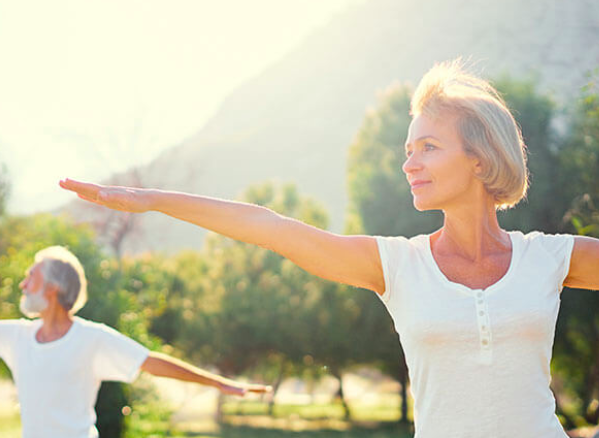
Everyone should exercise for physical and mental well-being. But being active is particularly important for people with Parkinson’s disease (PD). A recent PD Active webinar focused on the effects of exercise on Parkinson’s disease, including motor function improvement, cognitive function improvement, neuro-transmitters equilibrium, and oxidative stress reduction. We at Stanford Parkinson’s Community Outreach attended the webinar and are sharing our notes below.
The speaker, neurologist Dr. Nijee Luthra, described four types of exercises — dance, tai chi, qigong, and agility training, indicated what types of exercises are good based on disease-stage, and shared exercise guidelines. Exercise is an important way to slow the disease and control its symptoms; it helps maintain the ability to do everyday activities, and it protects the brain cells.
Dr. Luthra addressed how exercise is prevention. She said that people with PD and other forms of parkinsonism have a very high risk (2-4 fold increased risk) of fractures. The risk is even higher in those who are 60 years or older. These risks far exceed National Osteoporosis Foundation thresholds. Fractures increase disability and reduce independence. Dr. Luthra said exercise will help:
- Avoid falls and fractures (medications and DBS do not help balance)
- Avoid cardiovascular disease (heart attacks and stroke)
- Avoid depression
- Avoid back pain
- Avoid lonelines
Given the importance of exercise, check out these Stanford Parkinson’s Community Outreach webpages on live, virtual exercise classes and PD exercise videos:
In the question-and-answer session, the speaker encouraged people to work with a physical therapist (PT) or fitness trainer to develop an exercise program. Many PTs and fitness trainers teach the PD exercise classes listed on the web page above.
The webinar was recorded, and is accessible on YouTube here
My detailed notes are below. I have removed the basic overview of PD that was at the beginning of the webinar.
Regards,
– Sheela Sakariya
“Exercise as Medicine for Parkinson’s Disease” – Webinar Notes
Webinar Host: PD Active
Webinar Date: October 16, 2021
Speaker: Nijee Luthra, MD, PhD, neurologist at UCSF
Summary by: Sheela Sakariya, Stanford Parkinson’s Community Outreach
PD treatment
Need to target multiple pathways for PD in order to prevent loss of brain cells, slow down or potentially reverse the disease:
- Find a way to counter oxidative stress and inflammation
- Find a way to clear or stop the spread of toxic protein
- Find a way to enhance brain survival mechanisms
Exercise is the Key!
- Boosts overall brain resilience
- Delays cell loss and extends life
What is exercise?
Physical activity: any bodily movement produced by skeletal muscles that results in expenditure of energy, may encompass household, work, leisure, and sports related activities.
Exercise: type of physical activity; includes those activities that are planned, structured, repetitive, purposive in nature, and intended to improve one or more components of physical fitness.
Exercise and PD
- Motor function improvement
- Cognitive function improvement
- Neuro-transmitters equilibrium
- Dopamine neurons number
- Oxidative stress reduction
- Neuro inflammation reduction
- Neurotrophic factors
Exercise: Prevention, Compensation, and Neuroprotection
Prevention
People with PD and other forms of Parkinsonism have very high risk (2-4 fold increased risk) of fractures. The risk is even higher in those who are 60 years or older. These risks far exceed National Osteoporosis Foundation thresholds. Fractures increase disability and reduce independence. Exercise will help
- Avoid falls and fractures (medications and DBS do not help balance)
- Avoid cardiovascular disease (heart attacks and stroke)
- Avoid depression
- Avoid back pain
- Avoid loneliness
Compensation
- Learn new strategies/useful tricks: External cues, turning, break down task, start walking
- Use alternative parts of the brain
- Long pause between when cell loss begins to when one is diagnosed
- Compensating for loss of dopamine neurons
- Brain reshapes itself throughout life in responses to experience
- Exercise drives this compensation (exercise dependent plasticity)
- Helps the brain maintain old connections, form new ones, and restore lost ones
Neuroprotection
Relationship between cognition and balance
- Cognitively impaired older people fall twice more than cognitively intact
- PD patients with worse cognitive deficits have more falls
- Gait and balance are not automatic processes as PD progresses
Dual Tasking
- More difficult for people with PD
- Need more attention to walk and balance
- Reduced working memory
- Difficult to switch between tasks
- May not prioritize balance
Both cognition/balance and dual tasking can be improved with regular exercise and training. Neuroprotective effects of exercise on dopamine pathways include decreased loss of dopamine producing brain cells, increased dopamine release, and preserved nerve endings.
Types of Exercises
Dance in PD
Dance improves balance and targets specific PD related motor deficits such as flexed postures, rigidity, bradykinesia, postural instability, shuffling gait, cognitive impairment, and depression. Dance or care partner may serve as cues to facilitate movement. Dance is also social, engaging, caregiver fun and adaptable.
Tai Chi and Qigong in PD
These activities are more beneficial at improving postural control vs resistance training/stretching. Both Tai Chi and Qigong are helpful for motor and non-motor symptoms. Group exercise may be more beneficial than individual exercise.
Agility exercises in PD
Agility training is defined as a training that stimulates the ability to move and change the position of the body quickly and effectively, improving coordination, balance, speed, and enhancing reflexes. Agility training improves specific balance deficits, cognitive-gait interference, perceived functional independence, and quality of life.
Exercise guidelines: (from the Parkinson’s Foundation)
- Needs to be intense! Goal: 5-6/10 intensity
- Maximum heart rate (220-age) x 65-80% (example, 70 year old. 220-70= 150. Heart rate range during exercise: 98-120)
- Goal: 5 times/week for 30 mins or 150 minutes (2.5 hours) of moderate to vigorous exercise per week
- Needs to be challenging: makes you think
- Is something that you will commit to
- Mix different types of exercise such as above examples
- May include aerobic activity, strength training, balance/agility/multitasking, and stretching
- Meet a physical therapist specializing in Parkinson’s for an evaluation and patient specific direction
Exercise focus based on disease stage
Early
- Sports/agility
- Aerobic
- Strength
- Mental/dual task
Later
- Walking/transitions
- Tricks
- Fall prevention
All Stages
- Flexibility
- Postural alignment
- Large movements
- Deep breathing kinesthesis
Q & A Session
Question: What about swimming and brain benefits?
Answer: Swimming is also a great exercise for PD – it uses your brain and cognition as you are trying to coordinate your arms just like dancing and boxing. It is less accessible to people and that’s why people don’t do it as much. It’s a great way for dual tasking!
Question: Does insurance pay for exercise since you call it medicine?
Answer: That’s a good point! Since exercise is like medication, insurance should pay for it especially for a trainer or a caretaker who works with you. And exercise classes and gym memberships are expensive.
Question: Are there recommendations for finding a trainer in the East Bay?
Answer: Ask your physical therapist for recommendations! Go to Parkinson’s Foundation (parkinson.org) to find resources that will help you. Also, check out lsvtglobal.com for their programs and therapists in your area.
Question: In covid, some people with PD have lost a lot of muscle mass. What do you recommend?
Answer: Again, work with your physical therapist for weight training or strength training exercises. Walking an hour a day is a great aerobic activity even if it is slow. Check out the Fitness Counts program which has some great exercises for strength training.
Question: Which type of dance is the best?
Answer: Tango and ballet are the best types of dances for a person with PD.
Question: Do pullups and pushups count towards weight training?
Answer: Yes, they absolutely do! They are counted as weight training.