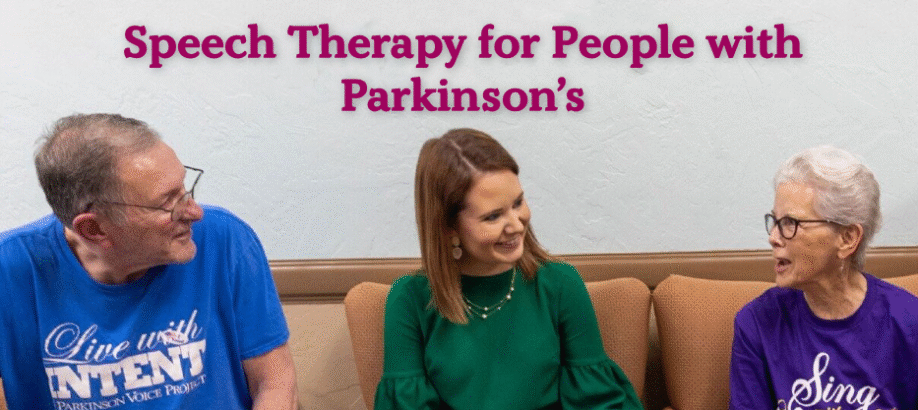
Earlier this month, there were two webinars presented on the Parkinson Voice Project and the “SPEAK OUT!®” program—a comprehensive, evidence-based approach to preserving and improving speech and swallowing for people with Parkinson’s disease. Speech language pathologist Julia Lidgard, SLP, presented “Living with Intention: Maintaining Your Voice with Parkinson’s SPEAK OUT!” for the American Parkinson Disease Association (APDA) Virginia Chapter. Two days later, Samantha Elandary, SLP, founder of the Parkinson Voice Project, was interviewed on a Being Patient Facebook live event titled “Parkinson Voice Project: Protecting Speech in Parkinson’s.”
Both presentations emphasized the message that up to 90% of people with Parkinson’s will experience speech and swallowing difficulties, yet many don’t receive treatment early enough—or at all. The consequences can be devastating. Without treatment, people may lose the ability to speak and swallow in the last five years of life. Research shows that 70% of people with Parkinson’s die of aspiration pneumonia if they don’t receive speech therapy. However, by employing the Parkinson Voice Project SPEAK OUT! Program, people maintain their voices and swallowing function for decades.
The SPEAK OUT! Program is based on the principle that humans have two motor systems. The automatic motor system (highly dependent on dopamine) and the intentional motor system (not as dependent on dopamine). By teaching people to speak with intent—taking speech from automatic to intentional—people with Parkinson’s can regain and retain their voice, often sounding completely normal again.
Key Takeaways:
Speech and Swallowing Changes Start Early: The earliest symptoms are a raspy or hoarse voice (doesn’t hurt), softer volume, and people asking you to repeat yourself. This often appears before other Parkinson’s symptoms are obvious.
Parkinson’s is a “Snowflake Disease”, meaning every person with Parkinson’s is different. When the speech and swallowing issues appear they vary by individual, but 90% of people with Parkinson’s (PwP) will experience these symptoms.
The Sensory Deficit Problem: PwP can have a sensory deficit—their voice can feel different to them than it sounds to others. Someone may think that they are speaking normally or even too loud when they are actually very quiet. This is why some people don’t seek treatment early enough.
Start Treatment Immediately: The earlier treatment begins, the easier it is and the better the outcome. Normal conversation is 72-78 decibels. The average improvement from therapy is 7 decibels. If you start at 65 decibels, you can sound completely normal again. If you wait until you’re at 50 decibels, you may improve to 60 but never reach normal volume again.
Speech Therapy is Free Through Research Centers: University research centers provide SPEAK OUT! at no charge. Insurance is not billed. You can participate from home via video.
The Program Works: Within 8 sessions (4 weeks), there’s noticeable improvement between pre-treatment and post-treatment recordings. People who started the program 5, 10, even 15 years ago are still maintaining strong voices today by practicing daily.
Daily Practice is Essential: Like muscle memory—if you don’t practice, you lose the skill. The Parkinson Voice Project provides free daily practice (17-20 minutes) that you can do live or watch later.
It’s About More Than Voice: SPEAK OUT! improves volume, articulation, breath support, vocal quality, intonation, and facial expression. In addition, it helps control saliva / reduce drooling and improves the ability to cough effectively, eat safely, and maintain quality of life.
The “Circle of Intent”: The program includes evaluation, education (27-minute video about automatic vs. intentional motor systems), digital materials (booklet and flashcards), 8 individual sessions (30 minutes, 2x/week for 4 weeks), weekly group classes for life, and re-evaluations every 6 months.
Speak With Intent, Walk With Intent, Live With Intent: The principle extends beyond speech—anything that used to be automatic (walking, eating, buttoning shirts) must now be intentional. This is the key to managing Parkinson’s.
Resources:
Parkinson Voice Project Website: ParkinsonVoiceProject.org
- Find certified SPEAK OUT! providers and research centers nationwide
- Free eLibrary with digital booklets, flashcards (photo flashcards, words, money, math, problem-solving)
- Free online SPEAK OUT! home practice sessions 5 days a week
- Free resources available to anyone, even while searching for a SPEAK OUT! provider
For more information on speech and swallowing you can visit the Stanford Community Outreach Website:
A recording of “Living with Intention: Maintaining Your Voice with Parkinson’s SPEAK OUT!” with Julia Lidgard, MS, CCC-SLP, can be found on the APDA Virginia Chapter YouTube channel.
A recording of “Parkinson Voice Project: Protecting Speech in Parkinson’s” with Samantha Elandary, MA, CCC-SLP, founder of the Parkinson Voice Project, can be found on the Being Patient Alzheimer’s Facebook page.
Now on to my notes,
– Elizabeth
“Living with Intention: Maintaining Your Voice with Parkinson’s Speak Out”
Speaker: Julia Lidgard, MS, CCC-SLP, Clinical Professor, University of Utah; Certified SPEAK OUT! Provider, Parkinson Voice Project
Webinar Host: American Parkinson Disease Association (APDA) Virginia Chapter
Moderator: Naomi McLeod, Program Director, APDA Virginia
Webinar Date: February 10, 2026
Summary by: Elizabeth Wong, Stanford Parkinson’s Community Outreach
Understanding Parkinson’s Disease and Dopamine
Dopamine is a neurotransmitter and hormone produced in the brain. It acts as a chemical messenger, transmitting signals between nerve cells. Dopamine is needed for:
- The brain’s reward system
- Regulating motivation, pleasure, mood, attention, and memory
- Motor control
- Reinforcing behaviors and making you want to repeat pleasurable actions
Things like walking, talking, and being motivated to do things happen because of dopamine.
How Parkinson’s Affects Dopamine
Parkinson’s is caused by dopamine-producing neurons dying or becoming impaired. By the time of diagnosis, a person with Parkinson’s has typically lost an estimated 60-80% of their dopamine-producing cells. Without enough dopamine, automatic movements are disrupted.
Parkinson’s is Characterized by Smaller Movements
Muscles become weak because they’re not used to their full capacity:
- Walking: shuffling feet rather than taking large steps
- Drinking: taking small sips rather than larger gulps
- Talking: mouth movements become much smaller, resulting in mumbling rather than clear enunciation
Automatic vs. Intentional Movements
Automatic movements (involuntary actions) are movements we do not think about—we just do them such as walking, talking, swallowing, or getting up out of a chair. All these movements are highly dependent on dopamine. People with Parkinson’s struggle to produce automatic movements because they’re so dependent on dopamine.
The Solution: Two Motor Systems
Humans have two motor systems:
- Automatic Motor System – Highly dependent on dopamine (doesn’t work well with Parkinson’s)
- Intentional Motor System – Not as dependent on dopamine (this is your “backup generator”)
The key is taking movements from automatic to intentional.
Walking with Intent: Instead of walking without thinking (shuffling), walk and pretend you’re stepping on every crack on the sidewalk. Every step, you’re reaching for that crack. This takes the movement from involuntary to voluntary.
Swallowing with Intent: A large majority of people with Parkinson’s have swallowing disorders that start early or develop gradually. Instead of swallowing without thinking, focus on each swallow.
How: Think of your Adam’s apple going up and down with each swallow. When eating and talking at the same time, stop talking and think about that Adam’s apple going up and down as you swallow.
Speaking with Intent: People with Parkinson’s are often told: “Speak up. I don’t hear you. What did you say?” SPEAK OUT! therapy doesn’t teach you to yell—it teaches you to speak every word with intent.
How: Pretend you’re speaking to a group of people in a conference room. Project your voice up and over your partner’s head. Speak every word with intent.
Speech is a highly automatic function. People with Parkinson’s have difficulty regulating volume and often don’t realize they’re getting quieter unless someone tells them.
What is Parkinson Voice Project?
The Parkinson Voice Project was founded by Samantha Elandary. SPEAK OUT! therapy is based on principles of motor learning and teaching of the late Daniel R. Boone, a speech pathologist. In the 1950s, Boone recognized that people with Parkinson’s could and did improve their communication skills simply by speaking with intent—taking something involuntary and turning it into a voluntary action. Parkinson Voice Project is the only nonprofit organization in the world solely dedicated to improving speech and swallowing in Parkinson’s.
Collaboration with Universities
Parkinson Voice Project collaborates with university speech clinics across the United States (and worldwide) to make the program accessible. These SPEAK OUT! therapy and research centers:
- Eliminate insurance and financial barriers by not charging for therapy
- Do not bill insurance
- Eliminate transportation challenges by offering treatment online
- Provide hands-on training for graduate students
- Conduct efficacy research on speech and swallowing disorders in Parkinson’s
When you join the SPEAK OUT! program through a research center, sessions are at no charge, insurance is not billed, and you participate from the comfort of your home.
What is the SPEAK OUT! Therapy Program?
The SPEAK OUT! Therapy program helps people with Parkinson’s and related disorders regain and retain their speech and swallow. Typically, the program can help you regain and then retain your speech for a considerable length of time after diagnosis.
What the Program Improves:
- Volume
- Articulation (movement of your mouth)
- Breath support for speech
- Vocal quality
- Intonation (up and down mannerisms when talking)
- Facial expression
Additional Benefits:
- Reduced drooling
- Improved swallowing
While not directly working on drooling and swallowing, research shows that learning to do everything with intent helps retain swallow function for much longer periods.
The Program Combines:
- Research-based treatment
- Education
- Individual Speak Out therapy
- Speak Out classes
- Daily home practice
The Seven Steps: Circle of Intent
Step 1: Speak Out Evaluation
Conducted by a certified SPEAK OUT! provider (a speech-language pathologist who has completed 13 hours of specialized training through Parkinson Voice Project). The evaluation is virtual and takes about 30 minutes. Research shows this is the ideal duration for staying actively engaged and getting the best benefits.
Step 2: Digital Booklet and Flashcards
Once enrolled, you get access to digital booklets and flashcards in the eLibrary—a great source of information. You must be enrolled in SPEAK OUT! therapy to access this.
Step 3: Educational Video (27 Minutes)
A video created by Parkinson Voice Project where patients, families, and friends learn about Parkinson’s and why speaking with intent is so important for managing the disease. It’s not just about speaking with intent—it’s about living life with intent across all areas.
This video is critical—it explains the difference between automatic and intentional motor systems and provides hope.
Step 4: Individual SPEAK OUT! Therapy Sessions
Patients and families work individually with a certified SPEAK OUT! provider to learn exercises and establish a consistent home practice routine.
Format:
- Two sessions per week for four weeks (8 sessions total)
- All from home
- All 30 minutes in duration
- If going through a research center, you work with graduate student clinicians online with a certified speech pathologist observing 100%
People with Parkinson’s need intensive practice, not intensive therapy. They need therapy to learn how to do the exercises, but then they practice twice a day, every day.
Step 5: SPEAK OUT! Classes (Weekly Group Sessions)
Around week 3-4 of therapy, you transition to weekly SPEAK OUT! classes. Once you’ve demonstrated mastery of exercises and are practicing speech with intent, you join a group (no more than 10 students per class).
You attend once a week for the rest of your life if you choose. These classes are completely free. If you can’t attend a particular week, you simply miss that meeting—no pressure.
This becomes a peer group where you:
- Do SPEAK OUT! exercises together
- Practice speaking with intent
- Share resources
- Connect with others who are proactive about living with intent
Step 6: SPEAK OUT! Monitor (Re-evaluations Every 6 Months)
Every 6-12 months, you’re pulled out of class for a 10-15 minute re-evaluation. If you need additional individual sessions because you’ve lost some skill, a “refresher” is set up.
At re-evaluation, the provider checks:
- Should anyone else in your family watch “What is Parkinson’s?” video?
- Have you been using flashcards?
- Can we train a family member (even in another state) to practice with you?
- Do you like your SPEAK OUT! class, or should we find a different one?
With Parkinson’s, whether physical therapy or speech therapy, it’s continuous therapy and practice—not something you do once and you’re done. You have to go back every 6 months and regroup.
The biggest reason: the sensory deficit. People with Parkinson’s can’t judge accurately on their own what needs to be done because it doesn’t feel the same way to them as it does to people listening to them.
Step 7: Daily SPEAK OUT! Home Practice
Using the booklet, flashcards, and Parkinson Voice Project online videos to practice daily. If you don’t practice, you lose the skill—it’s like muscle memory. If you don’t lift weights, muscles atrophy. If you don’t practice, you lose that intent to speak with decent volume.
Parkinson Voice Project posts a new video every day (17-20 minutes) that you can practice along with live or watch later. You’re not doing the exact same thing every day—new videos keep it fresh and engaging.
The SPEAK OUT! Program Can Be Provided Virtually
You do not need to leave your home. About 85% of SPEAK OUT! sessions are done virtually.
What you need:
- Good Wi-Fi so you can see and hear each other without difficulty
- A private space where you can be loud
People who thought they couldn’t improve their voice all showed definite improvement. There is some improvement for every person who participates. How much improvement depends on how much you practice.
The speaker demonstrated some practice exercises.
Cognitive Exercises: Since cognitive decline is common in Parkinson’s, every 30-minute session includes cognitive exercises to keep the mind moving.
Examples:
- Spelling words (forward and backward for those who want challenge)
- Stating the function of objects
- Identifying when you’d use items
- Labeling items
Reading and Conversation: Sessions include reading single words, phrases, and poetry to maintain reading skills with intent, plus conversational skills using intent. Constantly changing things up to keep it novel and fun.
Timeline for Progress: Within 8 sessions (4 weeks), there’s a noticeable difference between pre-treatment (day 1) and post-treatment (4 weeks) recordings if you practice daily and attend sessions.
Protecting Your Vocal Cords: The program doesn’t teach you to yell (which damages vocal cords). Also avoid whispering (equally damaging).
Recommendations:
- Drink lots of fluids throughout the day, especially during sessions, to keep vocal cords hydrated
- Don’t clear your throat
- Practice correctly—you won’t hurt your vocal cords
How to Access SPEAK OUT! Therapy
Visit ParkinsonVoiceProject.org to find research centers in your state. All research centers are listed. The speech pathologist must be licensed in your state to provide therapy. If you go through a university research center, there is no charge and insurance is not billed. Therapy is virtual so can be done anywhere. If you go through a private speech pathologist that is not a research center, they may charge.
Question and Answer for Webinar with Julia Lidgard
Question: How does SPEAK OUT! differ from the LSVT LOUD program?
Answer: Very similar. Research shows you don’t need hours of therapy at a time. With Lee Silverman Voice Therapy (LSVT LOUD) you start off strong but over weeks or days of doing hours of therapy, some fall off the wagon. The difference is that SPEAK OUT! requires less therapy time but it is still daily practice and it’s free if you go through a research center.
Question: How long does it typically take to make meaningful progress with regaining your voice?
Answer: Within the 8 individual sessions. We take a pre-treatment recording on day 1 and post-treatment recording on the eighth session. The difference is significant if you practice daily and attend the sessions. We keep you with us for life if you let us. We monitor you weekly during group classes and do refreshers every 6-12 months (or sooner if we see regression).
We have patients who started the SPEAK OUT! Program 5, 10, 15 years ago who are still maintaining their strong, useful, intentional voice today. We’re not curing Parkinson’s, but we can help you continue speaking with intent for a very long time if you continue to practice.
Question: What do you recommend to protect vocal cords?
Answer: We’re not teaching you to yell. We also don’t teach you to whisper because both are damaging to vocal cords. Drink lots of fluids during your day, especially during sessions, to keep vocal cords hydrated. We don’t ever want you clearing your throat. If you’re drinking lots of beverages and practicing correctly, you won’t hurt your vocal cords.
Question: Can you provide links to university research centers?
Answer: Visit parkinsonvoiceproject.org/therapy-and-research-centers/ — all centers are listed there.
Question: Is there a charge?
Answer: If you go through a university research center, there is no charge. But there are speech pathologists charging for this exact therapy—they’re just not research centers.
This concludes my notes for the February 10, 2026 webinar “Living with Intention: Maintaining Your Voice with Parkinson’s Speak Out” with Julia Lidgard, SLP. The following are notes from the February 12, 2026 interview with Samantha Elandary, SLP, founder of the Parkinson Voice Project.
“Parkinson Voice Project: Protecting Speech in Parkinson’s”
Interviewer: Deborah Kan, Founder, Being Patient
Guest: Samantha Elandary, MA, CCC-SLP, Founder, Parkinson Voice Project
Webinar Host: Being Patient
Facebook Live Event Date: February 12, 2026
Summary by: Elizabeth Wong, Stanford Parkinson’s Community Outreach
Question: When do people start to experience changes in speech with Parkinson’s disease? Do they appear early on?
Answer: Parkinson’s is often referred to as the “snowflake disease” because every person is different. When they’ll experience speech and swallowing issues will be different for every person. The earliest symptoms are:
- A voice that sounds raspy or hoarse
- A softer voice
- People asking you to repeat yourself
There’s usually not too much slurring or stuttering early on (sometimes, but that’s not typical). Voice changes are usually a softer, gravelly voice. It can be tricky because people may say, “Oh, my allergies are really bad. That’s why my voice is raspy.” Also, people with Parkinson’s don’t always recognize that they have a soft voice. The voice feels differently to the person with Parkinson’s than it sounds to others. When somebody leans in and asks them to repeat, they may not realize it’s them that has the problem—they might think the other person has a hearing problem.
Question: When you talk about voice changes feeling differently—can you describe that? Is it as benign as a hoarse voice, or is it something like a sore throat that hurts?
Answer: No, it never hurts. That’s the key with Parkinson’s. It’s not like going to a football game and cheering too much and ending up with a hoarse voice. If someone has a hoarse voice from cheering too much and they try to project their voice, they won’t be able to, they will sound worse. With Parkinson’s, it’s the opposite, if someone with PD has a gravelly voice, if they project their voice more and speak out, they will sound better.
The part about voice changes not feeling the same is referred to as a sensory deficit. There’s a sensory deficit related to Parkinson’s where when somebody is speaking, their voice feels differently to them than it really sounds. Some people with Parkinson’s will say, “My voice, when I speak out, sounds too loud.” I’ll have to say, “No, you don’t sound too loud. You feel like it’s too loud, but it sounds really good.”
Question: Why does Parkinson’s impact speech? What’s the connection to dopamine?
Answer: Parkinson’s is caused when neurons that produce the chemical called dopamine start to die or become impaired. By the time a person has any symptoms of Parkinson’s, they’ve already lost 60-80% of their dopamine-producing cells. How this connects to speech: Automatic movements—anything we do without conscious effort—require dopamine or are highly dependent on dopamine.
There are so many things we do throughout the day that are automatic. Before Parkinson’s, someone could walk down the street, talk to a friend, and eat an ice cream cone all at the same time without really thinking about it. With Parkinson’s, when walking, they have to purposefully pick up their feet—heel, toe—think about it more.
All those movements are normally automatic—but with PD those movements that used to be automatic have to now be intentional.
Fortunately, humans have two motor systems:
- Automatic motor system – Highly dependent on dopamine
- Intentional motor system – Not as dependent on dopamine
When people with Parkinson’s are purposeful, deliberate, when they really concentrate and focus, they can walk better, talk better, write better, get out of a chair better—do everything better. But it’s never going to be automatic again. Even as much as they practice and work on it, we do that to keep the muscles strong, but it will never be automatic again. People with Parkinson’s will always have to speak with intent and walk with intent.
Question: Tell me about the Parkinson Voice Project. Is it intervention early on? Is it right for anyone at any stage? Is there a point where therapy makes the most sense in terms of where you are in disease progression?
Answer: Parkinson Voice Project is the only nonprofit organization in the world solely dedicated to improving speech and swallowing in Parkinson’s. The earlier someone is treated, the easier it is. But even if somebody is having severe issues with swallowing and speech, they can still benefit from the SPEAK OUT! therapy program.
Example: Normal conversation is 72-78 decibels. The average improvement someone will make in speech therapy is about 7 decibels. I’ve had patients gain 14 decibels, but the average gained is 7 decibels. I want everybody to get their voice back up to their pre-Parkinson’s state. To do that, they should have a SPEAK OUT! evaluation as soon as they notice the problem or as soon as someone close to them says, “I think your speech is not as good as before.”
Question: What does voice therapy entail? Take us through from evaluation to what the actual therapy looks like.
Answer: On the Parkinson Voice Project website we depict the SPEAK OUT! therapy program as a circle. We call it the Circle of Intent. A new patient starts with a SPEAK OUT! evaluation. We try out some exercises to determine if this person will be a candidate for treatment and if it will benefit them.
Next, they watch a video with their family called “What is Parkinson’s?” This piece is really important. It emphasizes the difference between the automatic motor system and the intentional motor system. People with Parkinson’s have to start recognizing that their speech used to be automatic. Now they need to be intentional. They also have to have hope. They have to understand that we do have an intentional motor system—it’s like a backup generator that is not as dependent on dopamine, so it will work.
We educate the patient and family, then we orient them to the therapy materials they’ll need. We provide those materials at no charge. We have a SPEAK OUT! eLibrary with booklets and flashcards the patient will use every day.
Therapy is one-on-one with a certified SPEAK OUT! provider. Most patients in our clinic at Parkinson Voice Project receive two therapy sessions a week for 30 minutes.
People with Parkinson’s need intensive practice. They don’t need intensive therapy. They need therapy to learn how to do the exercises, but they need to practice, ideally twice a day, every day.
Around week 3 or 4, they transition to a weekly SPEAK OUT! class where they’ll be with a group (maybe 8 other people). They do the exercises together, practice speaking with intent, and share resources. It becomes a peer group—you are with people who are also proactive and learning to live their life with intent.
Then every 6 months, the patient comes back for a re-evaluation. We go through the circle:
- Is there anybody else in your family who should watch “What is Parkinson’s?” video?
- Have you been using flashcards? Maybe I can reorient you.
- Maybe you have a family member in a different state—can we train that person to practice with you once a week?
- Do you like your SPEAK OUT! class, or should I find a different one for you?
With Parkinson’s, it’s continuous therapy and practice. Every 6 months, you have to go back to the speech pathologist and regroup. Same with physical therapy. The biggest reason for this is the sensory deficit. For some PwP it can be difficult for them to judge on their own what needs to be done.
Question (audience): My Parkinson’s symptom is a bad stutter. Is there anything you could suggest to help control the stutter and improve my speech? So maybe it’s not always a raspy voice—is a stutter included in voice changes for Parkinson’s patients?
Answer: Yes and SPEAK OUT! therapy will help with that. The speech disorder related to Parkinson’s is called a motor speech disorder—the coordination of motor movements to produce speech. Some people are softer, some are raspy, some stutter, some talk too quickly, some speak too slowly. The focus of the SPEAK OUT! is to speak out.
In the past, if somebody had a stutter, we would try to tell that person to slow down. That is the worst thing you can do with Parkinson’s. Do not try to slow your speech down. Project it forward. When you speak with intent or speak out, you are taking control of your speech. All of a sudden when you do that, you will sit up straighter, you will slow down, your volume will be better, your articulation will be better, you’ll have better facial expression. Think of a tennis court and you’re projecting your voice forward—every word has to make it over the net. If you do that, it will work.
Question (audience question): Does Parkinson’s symptoms include a cough and phlegm production?
Answer: Yes. Coughing can be an early sign of a swallowing disorder. It is a sign that we are not using the muscles correctly (motor swallowing problem) or to their full potential. When we would normally swallow that phlegm, if the swallow is not as effective, we will feel it more. Also, sometimes people with Parkinson’s are not drinking enough water. When we drink more water, it thins out the secretion. As the muscles get stronger and the coordination of muscles gets better, we usually see that coughing goes away and they won’t notice the phlegm as much. The whole speech and swallowing mechanism is working better.
Question: Do voice and swallowing problems go hand in hand, or can you have them independently?
Answer: You can have them independently at first. But the main cause of death in Parkinson’s if somebody doesn’t receive treatment is aspiration pneumonia. Research shows that 70% of people with Parkinson’s—that will be the cause of death, aspiration pneumonia. At the Parkinson Voice Project, we have 505 people with Parkinson’s who we’re treating right now, that statistic of 70% die of aspiration pneumonia—that is not happening at our clinic. People can get better.
Question: Is it possible to have Parkinson’s and not have any voice issues?
Answer: 90% of people with Parkinson’s have speech and swallowing issues, so it is possible. I would say people diagnosed later in life—somebody diagnosed at 80 years old—their experience will be very different. Maybe they would never experience the swallowing issues. Somebody younger, it’s a little harder. They’re going to live with it for 30-40 years.
I want to mention another symptom of swallowing disorder: trouble managing saliva. People with Parkinson’s often say, “I feel like I have more saliva than everybody else in the world.” That’s not the case. Swallowing our saliva throughout the day is an automatic function. But because the automatic motor system isn’t working with Parkinson’s, swallowing is no longer automatic. Also, some people with Parkinson’s will have their posture down. If saliva is accumulating in the mouth and because of the sensory deficit someone might not be aware of it, then they tilt their head down and start drooling.
As the muscles get stronger, the person will swallow more. They’ll become more aware of how they’re speaking, more aware of that saliva, and swallow with intent. It used to be automatic; now it has to be intentional. This is why everybody has to watch that video before starting SPEAK OUT! therapy. If you miss that piece about automatic versus intentional, you’re missing a critical piece to the program.
Question: Do the intentional changes later turn automatic?
Answer: It will never become automatic because the automatic part of the brain needs dopamine. It won’t become automatic, but it will be easier. When somebody comes in for therapy, at first the muscles have become weak because they haven’t been using them. It’s not unusual for people to come in and say, “I can’t get my voice any louder. I can’t do it.” Then we show them SPEAK OUT! and they’re able to do it.
Question: Can you give us an example? What does it look like to give one exercise to make yourself louder?
Answer: Again, not louder. I want to make sure it’s not louder because you could speak with intent in a soft voice. It’s about taking control. We offer online SPEAK OUT! home practice sessions five days a week, so anybody can come practice with us on our website.
Here’s one exercise: We can count, but we’re going to count with intent. I’m going to project my voice forward.
If I count to 12, this is how I would do it: “One. Two, three.” (Then stop.)
Another exercise you could do with a partner that’s very good: count back and forth. If I say “one” and you say “two,” I’m going to project my voice over your head. You project your voice over mine. Like a game of catch, back and forth. When you do the SPEAK OUT! exercises, they need to be strong.
Question: What is the cost of not doing this? What does it mean to live with Parkinson’s and not have any voice therapy?
Answer: It’s devastating. If somebody with Parkinson’s does not receive speech treatment—they could live the last five years of their life not being able to speak and not being able to swallow. Before Parkinson Voice Project, people were getting hung up every time they tried to make a phone call because nobody knew there was somebody on the other end.
I don’t want to scare people. I want to give people hope. Treatment exists. If you go to our website, there are lots of resources that can help you today. Swallowing complications are life-threatening. Some people come in and say, “I don’t really care so much about my voice. I’m retired. I don’t give presentations anymore. Speech therapy for Parkinson’s is not just about being heard and understood, it’s about:
- Controlling your saliva
- Being able to cough (people with Parkinson’s whose muscles are so weak—when food or liquid goes down the wrong way, we’re supposed to cough to get it out, but if the muscles have gotten so weak, they’ll try to cough and it’ll barely come out because the breathing muscles are weak. When we cough, we take a deep breath and contract the muscles to cough. If muscles continue to get weaker, the person won’t be able to cough.)
- Being able to eat safely
- Being able to eat the food you want
I don’t just want to improve your speech for a month or a year or five years. I want you to maintain it all the way to the end of your life, and it is possible.
Question: Can you be proactive? Let’s say people have been diagnosed with Parkinson’s but aren’t experiencing symptoms yet. Can you use voice therapy to prevent problems down the line?
Answer: I encourage everyone who’s diagnosed to have a SPEAK OUT! evaluation. But if you don’t need therapy, we won’t recommend it. We might have you participate in one of our weekly SPEAK OUT! classes or our singing classes, but if you don’t need therapy, you don’t need it.
You can get a baseline evaluation and see where you are. Then in six months, you would have something to compare to. I will say most people need it, there’s always something to work on.