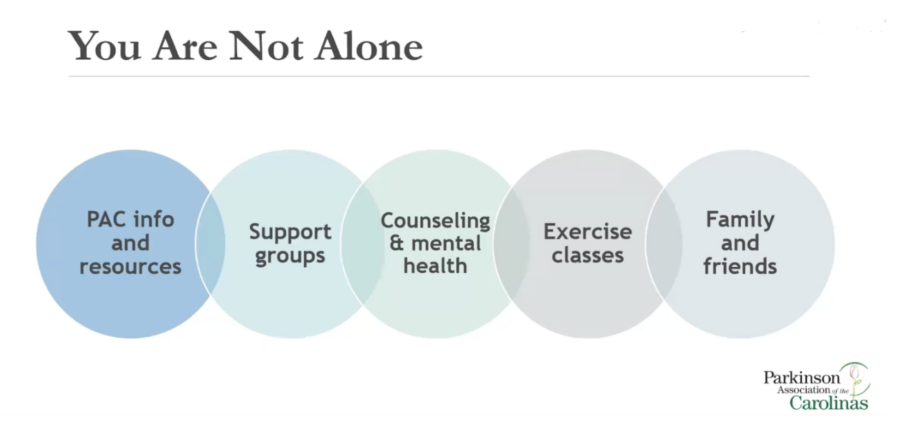
In early March 2026, the Parkinson Association of the Carolinas (PAC) hosted a webinar titled “Stronger Together: Finding Resilience in Life with Parkinson’s” about resilience, coping strategies, and grief management for people with Parkinson’s and their care partners. The core message shared: Resilience isn’t about being happy all the time or “toughing it out.” It’s about acknowledging your feelings, finding support in ways that work for you, and adapting to your new normal. You already have resilience—you can continue building it one step at a time with small, manageable strategies that focus on what you can control that day. The two speakers were Gillian Schultz, PAC’s program director, and Stephanie Reyes, a UNC Charlotte intern with PAC.
Key Takeaways
Resilience isn’t about being happy all the time. According to the American Psychological Association, resilience is successfully adapting to difficult life experiences through mental, emotional, and behavioral flexibility. You don’t have to feel good every day—resilience means acknowledging your feelings, finding support in ways that work for you, and adapting to your new normal.
Build a trusted care team and stay active. Find a neurologist or movement disorder specialist who coordinates with your primary care doctor. Include nurses, social workers, therapists, and mental health providers. At least 2.5 hours of vigorous exercise per week can help slow Parkinson’s progression—boxing, yoga, tai chi, dancing, whatever keeps you active.
Connect with others and ask for help. Being diagnosed can feel scary and isolating. Connecting with people who share the same fears builds hope and community. Don’t keep things to yourself—share thoughts and feelings with care partners and family. Maintain open communication. You don’t have to battle this alone.
Focus on what you can control today. You can’t control having Parkinson’s, but you can control how you manage it. Change your diet, improve sleep, start exercising, and manage stress. Build routine around your on/off times, but stay flexible. Let go of what you can’t control.
Grief is normal and non-linear. You grieve the loss of your former self, health, and expectations. This is valid for both the person with Parkinson’s and care partners. Feelings ebb and flow. When new symptoms appear, you may go back to feelings from diagnosis. That’s okay. Mourning your losses isn’t weak or giving up.
Hold on to purpose and celebrate small wins. You are not Parkinson’s disease—you have Parkinson’s disease. Keep doing what you enjoyed before (sometimes with modifications). Volunteer, spend time with people you love. Celebrate small successes: you got out of the house today, you participated in an exercise class. There’s always something good.
Resources
Webinar Recording:
Watch on PAC YouTube Channel
Stanford Parkinson’s Community Outreach Resources:
If you are lucky enough to live in Northern or Central California, join a support group (some groups are for caregivers only):
Or an in-person PD exercise class:
In other parts of the US or if you don’t want to leave home, consider a virtual group or an online community:
Or virtual PD exercise class:
Or meditation, virtual art therapy, or improv classes:
Managing grief and other emotions of caregivers:
Continue reading for detailed notes,
-Elizabeth
“Stronger Together: Finding Resilience in Life with Parkinson’s”
Presenters:
- Gillian Schultz, Program Director, Parkinson Association of the Carolinas (PAC)
- Stephanie Reyes, UNC Charlotte Intern with PAC (January-April 2026)
Webinar Host: Parkinson Association of the Carolinas
Webinar Date: March 4, 2026
Summary by: Elizabeth Wong, Stanford Parkinson’s Community Outreach
This presentation is not about fixing Parkinson’s disease. It’s about focusing on how to live your best today with the tools, energy, and resources you have right now. With the following information, take what feels helpful and relevant to you and leave anything that doesn’t. Not every strategy will fit every person.
What is Resilience?
According to the American Psychological Association: “Resilience is the process and outcome of successfully adapting to difficult or challenging life experiences, especially through mental, emotional, and behavioral flexibility and adjustment to external and internal demands.”
Resilience does NOT mean:
- You always have to be happy
- You have to feel good every day
- You have to “tough it out”
Resilience isn’t linear. You’re going to experience new challenges as Parkinson’s disease progresses.
Managing skills to handle what’s coming allows you to:
- Feel your emotions
- Deal with the changes
- Move forward
Coping is learning how to build resilience. We can all cope throughout our journey. Coping includes:
- Adapting to change
- Managing your symptoms and emotions
- Protecting your quality of life
- Staying connected and supported
- Accepting how things are right now (things may be different tomorrow, were different yesterday, but accepting right now is one way to cope)
Ten Coping Strategies
1. Build a Trusted Care Team
Finding a neurologist or movement disorder specialist who:
- Explains things the way you need them explained
- Prescribes medications and tries things to see what works best for you
- Coordinates with your primary care doctor
Other helpful medical care team members:
- Nurses and social workers on the care team can provide helpful resources
- Outpatient therapies: physical therapy, occupational therapy, speech therapy
- Mental health providers
2. Exercise and Stay Physically Active
According to research:
- At least 2.5 hours of vigorous exercise per week can help slow the progression of Parkinson’s disease
- Helps treat balance issues
- Builds strength
- Improves general mobility
- All of these improve quality of life, which helps you cope with diagnosis
3. Support Your Mental and Emotional Health
Anxiety, apathy, and depression are common Parkinson’s symptoms. Getting support for these symptoms can make a big difference. Options:
- Mental health counseling—there’s nothing to be ashamed of to reach out to a therapist or counselor
- Support groups—connecting with other people makes a big difference
- Medication if you need it—there’s nothing wrong with taking medication to deal with a mental health symptom
For care partners: There may be times your mental health is suffering. Getting treatment for that is okay.
4. Knowledge is Power
Learning about your disease, being informed about treatments, and learning tools to make informed healthcare decisions can help reduce stress and empower you with skills to advocate for the right treatment. While it’s not possible to know everything, and sometimes too much information can add to fears, being prepared for what’s ahead and knowing how to manage your disease are powerful tools in building resilience and coping.
5. Connect with Others Who Get It
Being diagnosed with Parkinson’s disease can feel scary and isolating. Many people fear what others will think or become self-conscious. By connecting with people who share the same fears and feelings:
- You learn how each person deals with their Parkinson’s
- Helps build hope
- Helps build bonds
- These might become people you call on the phone and have conversations with outside support groups
No matter where you are in your experience with Parkinson’s, that community is such an important piece.
6. Build Routine (But Stay Flexible)
Parkinson’s can be unpredictable, so routines can help—but it’s also important to stay flexible. With a routine, you can learn when your ON and OFF times are and when you’re more likely to feel tired or have energy throughout the day. You can then build a routine for running errands or attending exercise classes around those times. Routine helps build a sense of normalcy, which is really important in coping.
7. Focus on What You Can Control
You’ve been diagnosed with Parkinson’s disease, and unfortunately there’s nothing you can do about that. But you CAN control:
- How you look at the future
- How you manage your Parkinson’s disease today
Even if you haven’t taken steps to make healthy lifestyle choices in the past, there’s no time like the present:
- Start by changing your diet – Have a healthy diet
- Improve sleep – While sleep can be a challenge for people with Parkinson’s, take steps to make your sleeping space most conducive to sleep
- Start exercising – Even if you’ve never exercised a day in your life, today is the day to start
- Manage stress – Stress does make things harder
- Let go of things you can’t control – You can control how you’re going to tackle and battle Parkinson’s every day
8. Manage Your Stress Mindfully
Stress can make symptoms worse. Find ways to manage stress that work for you. Different options:
- Mindfulness and meditation
- Music – Playing or listening has powerful benefits. Actually changes the physiology in your body.
- Prayer
- Exercise – If you take yoga classes, they build mindfulness into it. Focusing on whatever your exercise is can reduce stress.
- Breathing exercises
9. Include Your Care Partners
Parkinson’s disease doesn’t just affect the person diagnosed. It affects your entire family: spouse, children, parents, anybody in your personal circle. Maintaining open communication is essential for coping and building resilience.
Don’t keep things to yourself:
- Share your thoughts and feelings with them
- They may be having thoughts and feelings too that they’d like to share with you, but they’re not sure if they can
10. Hold On to Purpose and Joy
Don’t forget the things you enjoyed before your Parkinson’s diagnosis:
- You can still participate in hobbies (sometimes you may have to modify how you do that hobby, but it’s still possible)
- Go out and volunteer—there’s something about helping others that gives us purpose in life
- Spend time with the people you love
While what you were expecting of your future has changed, you still have purpose.
You are not Parkinson’s disease. You have Parkinson’s disease.
By maintaining that positive mindset, you have the skills to cope with your Parkinson’s and be strong and resilient.
Managing Grief
Experiencing grief is normal when dealing with a Parkinson’s diagnosis—for both the person with Parkinson’s disease and their family and care partners. Grief can be a response to:
- Loss of our former self
- Loss of our former health
- Loss of our identity
- Loss of our expectations
Your feelings can ebb and flow. You may be okay sometimes and not okay other times—and that’s okay. Acknowledging grief is an important part of managing grief.
Mourning your losses isn’t weak. It doesn’t mean you’re giving up. It’s just something you need to deal with so you can accept how things are today.
When managing grief:
- Continue taking care of yourself
- Connect with others: leaning on your friends and families can be very helpful
- Ask for help
- Keep your routines and normalcy
For care partners managing grief, grieving the life you thought you were going to have with your spouse, parent, child, or whoever it is—this is a valid feeling. It’s important for care partners to continue to care for themselves, set boundaries on what you can manage every day, acknowledge your feelings, and connect with other care partners.