In October 2026, No Silver Bullet 4 PD hosted a webinar titled “Changing the gut to change Parkinson’s: Faecal Microbiota Transplantation (FMT),” featuring Arnout Bruggeman, MD, a movement disorders neurologist and Parkinson’s researcher at Ghent University Hospital in Belgium. Dr. Bruggeman explained the gut-brain axis and reviewed animal and human research on faecal microbiota transplantation (FMT), which is the transfer of gut bacteria from a healthy donor into a person with Parkinson’s. He also shared results from his own clinical trial and plans for a larger follow-up study.
The gut is closely linked to Parkinson’s. Constipation and other gastrointestinal symptoms often appear years before motor symptoms. People with Parkinson’s show changes in their gut bacteria, signs of intestinal inflammation, and a weakened gut barrier (“leaky gut”). The misfolded protein alpha-synuclein can appear in the gut before it is found in the brain. These patterns are seen in studies around the world despite major differences in diet.
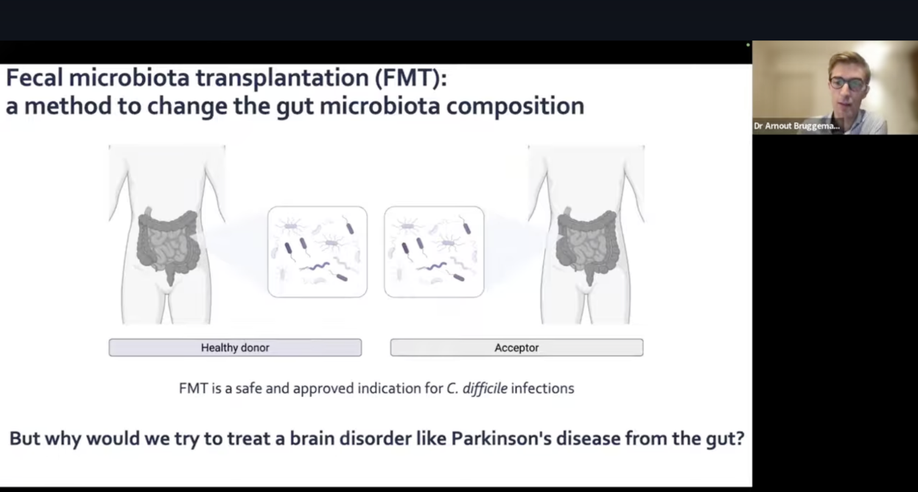
FMT is a way to change the whole gut ecosystem. FMT transfers gut bacteria from a carefully screened healthy donor into the gut of a person with Parkinson’s. It is already an approved, safe treatment for certain antibiotic-resistant gut infections (Clostridioides difficile). Dr. Bruggeman compared the gut to a forest. A single probiotic is like planting one oak tree in a pine forest, where it may simply die off, while FMT aims to replace the whole forest.
Dr. Bruggeman’s trial showed a modest but clinically meaningful motor benefit. In his 46-person, double-blind, placebo-controlled trial, a single FMT delivered into the small intestine was associated with better off-medication motor scores at 12 months compared with placebo, along with less worsening of constipation. Side effects were mild and temporary. However, the placebo group also improved for several months. And results from other FMT trials have been mixed.
Who responds best is still an open question, and early results were surprising. In Dr. Bruggeman’s trial, some donors’ stool led to improvement in one person but not in another, which suggests that which donor a person received did not, on its own, determine response. The characteristics of the person receiving the transplant may matter more. At the start of the study, people who responded well tended to have less constipation, fewer non-motor symptoms, and a more diverse gut microbiome. This was the opposite of what researchers expected: they had predicted that people with more constipation and more disrupted gut bacteria would benefit most. Dr. Bruggeman stressed that more research is needed before patients can be selected for FMT based on these traits.
FMT is not ready for routine clinical use. Larger, better-standardized studies are needed to confirm benefit and to work out the best method, the ideal donor, and the ideal recipient. A new multicentre trial in Belgium and The Netherlands is planned. If FMT proves effective, Dr. Bruggeman sees it as a possible add-on to existing treatments, not a replacement for levodopa or other symptomatic therapies.
Diet and exercise also shape the gut microbiome. Dr. Bruggeman does not currently recommend any specific probiotic, noting that some contain bacteria that may break down levodopa. A varied diet and regular exercise both influence gut bacteria. In his view, exercise remains the only intervention with some evidence for affecting disease progression.
Resources
The recording of this webinar is posted on the No Silver Bullet 4 PD YouTube channel
For related reading on the gut-brain connection in Parkinson’s, see this Stanford Parkinson’s Community Outreach blog post:
For those who live in the Stanford area, see recent recordings of researchers recruiting people with PD and healthy controls for GI research (gut-brain studies, EGG study, and PhD study):
Further reading from the speaker, mentioned in the webinar, is an open-access review:
The published results of Dr. Bruggeman’s clinical trial (the GUT-PARFECT trial):
Keep reading for detailed notes.
— Elizabeth
Changing the gut to change Parkinson’s: Faecal Microbiota Transplantation (FMT)
Speaker: Arnout Bruggeman, MD, movement disorders neurologist and Parkinson’s researcher, Ghent University Hospital, Ghent, Belgium
Moderator: Michel Planquart, No Silver Bullet 4 PD
Webinar Host: No Silver Bullet 4 PD, United Kingdom (nosilverbullet4pd.org)
Webinar Date: October 19, 2026
Summary by: Elizabeth Wong, Stanford Parkinson’s Community Outreach
[Editor’s note: These notes use “faecal,” the British spelling of “fecal,” to stay consistent with the title of this webinar, hosted by the UK-based organization No Silver Bullet 4 PD.]
What Is Faecal Microbiota Transplantation (FMT)?
FMT is a method of changing the composition of the gut microbiota, the community of microorganisms living in the intestines. Put simply, gut bacteria from a healthy person (the donor) are transplanted into the patient (the recipient). FMT is already a safe and approved therapy for treating infections with antibiotic-resistant bacteria such as Clostridioides difficile (C. diff), so its long-term safety is known from that use. Dr. Bruggeman noted that FMT is also a research tool for learning more about the gut-brain axis in Parkinson’s and other diseases.
The Gut Microbiome and the Gut-Brain Axis
The gut microbiota includes not only bacteria but also fungi, viruses, and archaea (single-celled microorganisms). Together, these microorganisms carry more than 100 times as many genes as the human genome. In Dr. Bruggeman’s words, this means we are in some sense “in the minority” in our own bodies.
The gut microbiota helps to:
- Regulate gastrointestinal motility (movement of food through the gut)
- Absorb and metabolize nutrients from food
- Modulate the immune system
- Maintain intestinal health
It does this in several ways:
- Producing neurotransmitters and amino acids
- Triggering the release of immune signaling molecules (cytokines and chemokines)
- Stimulating the release of gut hormones
- Producing microbial metabolites such as short-chain fatty acids
Some bacteria can even produce a protein called curli, which can promote the clumping of alpha-synuclein, the protein that accumulates in the brain in Parkinson’s.
The gut-brain axis has three main communication pathways, which interact with one another and work in both directions:
- Nerve pathway: the vagus nerve, a direct connection between the brainstem and the intestine
- Immune pathway: for example, through inflammation
- Hormonal (endocrine) pathway: gut bacteria can influence hormones
Why the Gut Matters in Parkinson’s
Although Parkinson’s is still diagnosed based on motor symptoms, many people experience non-motor symptoms years earlier. Constipation and other gastrointestinal symptoms are among the most common. Other evidence linking the gut to Parkinson’s includes:
- Alpha-synuclein can appear in the gut before it appears in the brain, in a subset of patients
- People with Parkinson’s have a changed gut microbiota composition
- There are signs of intestinal inflammation and decreased gut barrier integrity (“leaky gut”)
Studies comparing gut bacteria in people with and without Parkinson’s have been done around the world. Despite big differences between countries and diets, similar general changes appear. These include fewer bacteria that produce short-chain fatty acids, which help protect against inflammation, and changes in bacteria associated with breaking down the protective gut barrier.
Body-First and Brain-First Subtypes
One recent hypothesis proposes two subtypes of Parkinson’s:
- Body-first: the disease process begins outside the brain (for example, in the gut) and then spreads to the brain
- Brain-first: the disease process begins in the brain and may later spread to the rest of the body
The body-first subtype is associated with more non-motor symptoms, more constipation, and alpha-synuclein detected more often outside the brain. Intuitively, one might expect people with a body-first subtype to respond better to changing their gut microbiota. As Dr. Bruggeman explained later, his trial data suggested otherwise.
Evidence from Animal Studies
Dr. Bruggeman highlighted two types of animal studies:
- Genetic mouse model: Mice bred to overproduce alpha-synuclein normally develop alpha-synuclein clumps in the brain, symptoms, and gut bacteria changes. When these mice were raised from birth in a completely germ-free (sterile) environment, they developed almost no clear alpha-synuclein clumps and no clear symptoms, even though they still overproduced the protein. When gut bacteria from a person with Parkinson’s were later transplanted into them, the symptoms and brain pathology appeared. This suggests that gut bacteria can drive the disease process, at least in this model.
- Toxin-based mouse model: Mice injected with certain toxins develop symptoms, alpha-synuclein clumps, brain inflammation, and gut bacteria changes. When gut bacteria from a healthy person were transplanted into them, their symptoms improved. What was happening in the brain also improved, with less inflammation and less cell loss.
Across many animal studies, FMT from healthy donors has generally been associated with:
- Improved motor and gut symptoms
- Less gut inflammation and better gut barrier integrity
- Less loss of dopamine-producing neurons
- Less brain inflammation
Dr. Bruggeman cautioned that some publication bias (positive results being more likely to be published) is likely.
How FMT Is Performed
- Donor selection: Donors are screened very strictly according to international guidelines, using questionnaires, blood tests, and stool tests to rule out infections and other health problems.
- Stool processing: The donated stool is processed in a specialized lab. Processing should take place in an oxygen-free (anaerobic) environment, because many gut bacteria are damaged by oxygen.
- Recipient preparation: The recipient’s symptoms and medications are carefully documented, and they undergo bowel cleansing with laxatives. Whether antibiotics are also needed is still debated; Dr. Bruggeman’s trial did not use them.
- Delivery: The solution is delivered either by colonoscopy into the colon (large intestine), or higher up into the small intestine through a tube.
- Future possibility: Freeze-dried FMT capsules taken by mouth are being explored. So far, they do not appear to change the gut microbiota as effectively as colonoscopy or small-intestine delivery.
Dr. Bruggeman’s Clinical Trial – GUT-PARFECT
Dr. Bruggeman described his double-blind, placebo-controlled randomized trial at Ghent University Hospital:
- Participants: 46 people with mild to moderate Parkinson’s, roughly between the ages of 50 and 65
- Treatment group: 22 people received FMT from a healthy donor
- Placebo group: 24 people received a transplant of their own gut bacteria (an “autologous” transplant)
- Delivery: a single treatment, given through a tube passed through the nose, esophagus, and stomach into the small intestine. This route was chosen to reach the small intestine’s microbiome, and because the small intestine is more densely connected to the vagus nerve than the colon. It is more technically challenging than colonoscopy.
- Follow-up: clinical evaluations, questionnaires, and blood and stool samples at baseline and at 3, 6, and 12 months
Safety: There were no serious adverse effects. In the first week, some participants had temporary gastrointestinal discomfort, such as bloating or diarrhea.
Constipation: Colon transit time is a measure of constipation. Participants swallowed small marker pellets daily for six days, then had an abdominal X-ray on day seven; the more pellets remaining, the slower the colon. Over one year, the placebo group showed slower transit (more constipation), while the treated group remained more stable. This difference was statistically significant.
Motor symptoms (primary outcome): The main outcome was the motor examination portion of the MDS-UPDRS (Movement Disorder Society–Unified Parkinson’s Disease Rating Scale), the scale most commonly used in Parkinson’s trials. At 12 months, the treated group showed a 5.8-point greater improvement than the placebo group. This exceeds the 3.25-point difference generally considered clinically meaningful. The treated group improved gradually over the year. The placebo group also improved at 3 and 6 months before declining again by 12 months.
Understanding the Placebo Effect
Dr. Bruggeman offered two possible explanations for the large improvement in the placebo group:
- A transplant of one’s own gut bacteria may not be as inactive as once thought. Growing evidence shows it can cause temporary changes in the gut microbiota.
- At 3 months, all participants underwent a second bowel cleansing to prepare for a colonoscopy to collect gut tissue samples. Bowel cleansing itself may cause temporary positive effects, as other studies have described.
Results from Other FMT Studies
Dr. Bruggeman highlighted a trial from Finland that enrolled people with Parkinson’s who had a clearly abnormal gut microbiome (“dysbiosis”) and delivered FMT by colonoscopy. That trial found no clear difference in motor scores between groups. However, the treated group was taking somewhat less Parkinson’s medication at one year than the placebo group. He noted this is interesting because lab studies show that certain gut bacteria can break down levodopa, so changing the gut microbiota might affect how well levodopa works.
The published literature on FMT in Parkinson’s so far includes:
- Two single-patient case reports
- Five open-label studies (no placebo group; participants knew they were treated)
- Six double-blind, placebo-controlled trials, including two using freeze-dried FMT
The controlled trials differ widely in who was recruited, disease duration, donor selection, bowel preparation, delivery method, and follow-up timing, which makes direct comparison difficult. Of the six, two showed improvement in motor symptoms, and most showed improvement in gut or other non-motor symptoms. Data on what actually changed in the gut microbiota are still lacking, including from Dr. Bruggeman’s own trial, which is still being analyzed.
Who Might Respond Best to FMT?
In a follow-up (post hoc) analysis of his trial, Dr. Bruggeman defined “responders” as people whose motor score improved by more than 3.25 points. Among the 22 treated participants, 14 were responders and 8 were non-responders.
- Donors: The trial used 15 healthy donors. Five donors were linked to both a responder and a non-responder, suggesting that donor characteristics alone do not determine response.
- Recipients: People who responded well were more likely, at the start of the study, to have:
- Shorter colon transit time (less constipation)
- Less REM sleep behavior disorder (acting out dreams during sleep)
- Fewer motor fluctuations
- Less severe non-motor symptoms
- Greater gut microbiome diversity (less dysbiosis)
This was the opposite of what the researchers expected. They had predicted that people with a more body-first profile, with more constipation and more dysbiosis, would be the best candidates. More research is needed to understand what makes an ideal donor and an ideal recipient.
The Next Multicentre Clinical Trial
Dr. Bruggeman’s team is starting a new, larger trial:
- Approximately 184 participants, half receiving healthy-donor FMT and half receiving placebo
- This time, the placebo will be a water solution rather than the participant’s own gut bacteria
- Assessments at baseline and at 3, 6, and 12 months
- No colonoscopy after the FMT, to avoid the effect of a second bowel cleansing
- Inclusion criteria similar to the first trial
- Sites in Ghent and Leuven, Belgium, and Leiden, The Netherlands
Dr. Bruggeman closed with these points:
- FMT is being investigated as a potential treatment for neurological disorders, especially Parkinson’s.
- FMT is safe, but its effects are still variable, including positive effects in placebo groups.
- Optimized multicentre studies are needed.
- Many questions remain open, including the best FMT method and what makes an ideal donor and recipient.
- Trials are difficult to compare because of differences in methods, so more consensus on methodology is needed.
- It is still too early to pre-select patients for FMT trials based on particular characteristics.
Questions and Answers
Q: FMT may speed up transit through the intestine, and constipation reduces how well levodopa works. Could FMT simply be making levodopa work better, rather than improving the underlying disease?
A: Dr. Bruggeman agreed this is plausible. Studies of FMT in people with constipation alone show it can improve colon transit time, which could affect medication. In his trial, however, motor scores were measured in the “off” medication state, at least 8 hours after the last levodopa dose and 48 hours after the last dopamine agonist dose, to filter out medication effects. His team is also studying whether changing the gut microbiota affects how levodopa is absorbed into the blood. They are doing this by taking repeated blood samples after a levodopa dose before and after FMT. Those results are still being analyzed, though early indications suggest there may be an effect.
Q: Is the gut only involved when alpha-synuclein is present, or do people without major alpha-synuclein problems also have gut issues?
A: Dr. Bruggeman was not sure this has been clearly studied. In his interpretation of the current literature, alpha-synuclein in the gut is not necessary for gut symptoms, gut inflammation, or problems with gut barrier integrity. He added that whether alpha-synuclein is a driver of Parkinson’s or simply a bystander is itself an ongoing debate in the field.
Q: Why do some toxin-based animal models of Parkinson’s (MPTP, rotenone) show gut changes while another (6-OHDA) does not?
A: Dr. Bruggeman explained that 6-OHDA is usually injected directly into the brain to damage dopamine-producing cells. MPTP and rotenone are more similar to certain pesticides and are often given by mouth, and studies using rotenone describe many gastrointestinal symptoms. He was not aware of a 6-OHDA model showing clear gut changes. The difference may relate to how the toxin is given. If one accepts the body-first/brain-first hypothesis, one model may also resemble a brain-first form of disease and the other a body-first form. He noted that every animal model has advantages and disadvantages, and that Parkinson’s in people is far more complex.
Q: Does the age of the donor make a difference to the outcome? Would younger donors be better?
A: Because donors must be as healthy as possible, they tend to be young. That raises the question of whether transplanting bacteria from a young person into an older person with Parkinson’s is ideal. This question is intriguing. It might be more logical to find a donor of similar age who is also very healthy, but researchers are limited by who volunteers and passes the screening. He added that animal research shows the age of the mouse affects Parkinson’s models.
One audience member referenced research suggesting young blood plasma has benefits compared with old plasma, and said she would prefer a younger donor such as a child or relative. Dr. Bruggeman noted one drawback of a young donor: there is no way to know what conditions they may develop in the future.
Q: If FMT proves beneficial, when might it be clinically available? Are there major hurdles?
A: A big advantage of FMT is that it is already available in many places as an approved treatment for antibiotic-resistant infections, so implementation would not be a major barrier. However, much more evidence is needed that it works in Parkinson’s. Because not all published studies have shown positive results, a confirmatory multicentre study is needed before FMT can be used in clinical practice. Longer term, Dr. Bruggeman hopes that what is learned from FMT will lead to new therapies that are easier to deliver.
Q: If constipation is worsened by levodopa, why isn’t there more research into other ways of delivering levodopa, such as nasal sprays?
A: Dr. Bruggeman said there is increasing research into ways of delivering levodopa that bypass the gastrointestinal system. These include nasal sprays, inhaled levodopa (absorbed through the lungs), medication pumps that bypass the stomach, and subcutaneous (under-the-skin) delivery. In many people with Parkinson’s, the stomach and gut are slow, which makes it unpredictable when levodopa reaches the small intestine, where it is absorbed. He noted that these are all symptomatic therapies.
Q: Could FMT work for other diseases, such as those driven by TDP-43 or tau (for example, ALS or frontotemporal dementia)?
A: Interest in FMT is growing for other conditions. These include inflammatory bowel diseases such as Crohn’s disease and ulcerative colitis, where several studies show positive effects, and even depression. Among neurological disorders, Parkinson’s has the most evidence that the gut is important, which is why it is somewhat ahead in the field. For ALS and tau-related conditions such as frontotemporal dementia (FTD), progressive supranuclear palsy (PSP), and corticobasal degeneration (CBD), Dr. Bruggeman said it is still unclear whether gut microbiota play a role. More animal research is needed before moving to clinical trials.
Q: Did you measure short-chain fatty acids, or the bacteria that produce them, as a biomarker in donors and patients?
A: Not yet. The team’s initial analysis used a technique (16S rRNA sequencing) that gives a more general picture of which bacteria are present. A more detailed technique (shotgun metagenomics), which can show both which bacteria are present and what they do, is still being analyzed. The team has also not measured short-chain fatty acids directly in stool, which is technically difficult because these compounds are volatile.
Q: Are probiotic drinks likely to help with Parkinson’s?
A: Probiotics are drinks, yogurts, or supplements containing live bacteria, taken with the idea of changing gut microbiota composition, at least temporarily. Dr. Bruggeman said it is currently very difficult to say which bacteria would be beneficial, and he does not recommend any particular probiotic in his clinic. One concern is that some probiotics contain bacteria known to break down levodopa. Taken often, especially together with levodopa, they could make the medication work less well. He returned to his forest analogy: FMT aims to change the entire ecosystem, while a single probiotic strain may simply not settle in.
Michel Planquart (moderator/host) shared that a previous No Silver Bullet speaker had suggested a diverse diet can achieve similar goals to probiotics. He noted that he takes probiotics himself and was not advising others to stop, but that it is worth considering whether they are still needed.
Q: Can dietary changes significantly modify the gut microbiota in Parkinson’s?
A: Yes. Diet has a big influence on the gut microbiota and produces broader changes than adding a single type of bacteria through a probiotic. Dr. Bruggeman added that exercise also changes gut microbiota composition, and is important in Parkinson’s for many other reasons as well.
Q: Does fasting for a period help improve the gut microbiota?
A: Fasting will cause some changes in the gut microbiota, and there are studies on this. However, the changes appear to last only as long as the diet is continued; when the diet changes, the microbiota can revert to how it was before. Whether fasting is beneficial in Parkinson’s is not yet known from the medical literature.
Q: If FMT becomes available, would it be a complement to treatments like levodopa and deep brain stimulation (DBS), or a replacement?
A: Dr. Bruggeman distinguished between symptomatic therapies and therapies that affect disease progression. In his view, exercise is currently the only intervention with some evidence for affecting progression. His team’s hypothesis is that FMT could potentially have a disease-modifying effect, though that is difficult to prove in a study. If FMT is beneficial, he sees it as an add-on rather than a replacement. Dopamine-based therapies treat motor symptoms caused by dopamine deficiency, and FMT would not replace those effects.
Q: Has disease stage or duration been examined as a predictor of response? Could FMT work better earlier in the disease?
A: FMT trials, like Parkinson’s clinical trials in general, have mostly enrolled people in earlier stages (Hoehn and Yahr stages 1 to 3). The longer someone has had the disease, the less chance there may be of seeing a clear disease-modifying effect. Results so far are therefore only available for earlier-stage disease. Dr. Bruggeman described a stepwise approach as logical. If FMT is beneficial in early stages, it can then be tested in later stages, but if it does not work in early disease, he does not expect it to work in later disease.