
Every month, Stanford Parkinson’s Community Outreach produces a list of Parkinson’s-related webinars and virtual meetings with speakers. Here’s our October 2026 list.
… Full Story>Every month, Stanford Parkinson’s Community Outreach produces a list of Parkinson’s-related webinars and virtual meetings with speakers. Here’s our October 2026 list.
… Full Story>
In July 2026, the American Parkinson’s Disease Association (APDA) hosted a webinar on strategies for communicating effectively with your doctors, for those with Parkinson’s disease (PD) and their care partners. Occupational therapist Sydney Settle discussed how to prepare for your appointments so you can make the most of your limited time with your doctor. Her advice was focused on talking with the neurologist, as the center of the care team for managing PD, but these strategies are useful for talking with healthcare professionals of any specialty.
… Full Story>
For this installment of Parkinson’s Perspectives, APDA spoke with three inspiring musicians about the role music has played in their lives and how PD has changed the way they approach it. They reflect on the challenges they’ve faced, the creative adjustments that have helped them keep playing, and the lessons they’ve learned along the way.
… Full Story>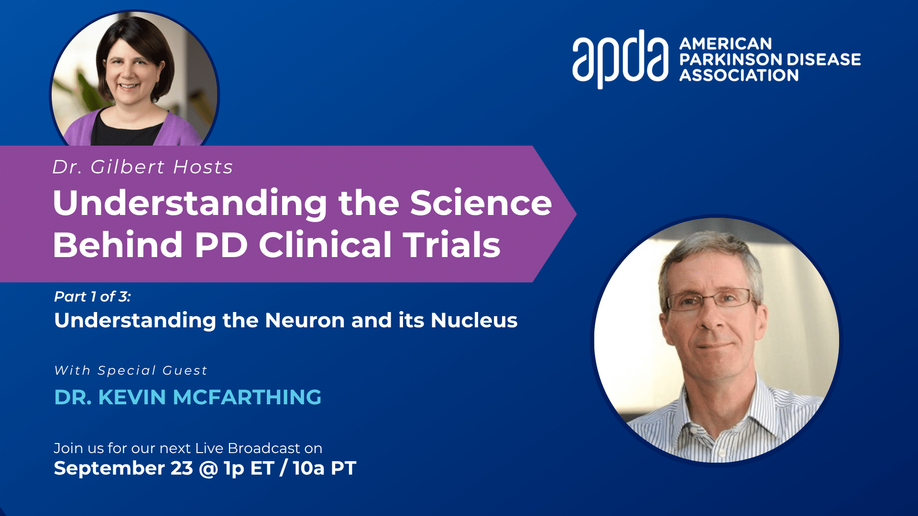
You don’t need a PhD in biochemistry to understand the exciting developments in Parkinson’s disease (PD) research. This special series by the American Parkinson Disease Association (APDA) makes PD research and clinical trials accessible—no scientific expertise required. The APDA’s Dr. Rebecca Gilbert along with Dr. Kevin McFarthing—a biochemist, PD clinical-trials expert, and person with PD—will present a three-part series, “Understanding the Science Behind PD Clinical Trials.” The dates are Sept. 23, Oct. 14, and Nov. 12. Register for all three today.
… Full Story>
In July 2026, the American Parkinson Disease Association (APDA) hosted a webinar on three treatments for Parkinson’s disease (PD): deep brain stimulation (DBS), focused ultrasound (FUS), and stereotactic radiotherapy (SRT). Three different neurosurgeons discussed the three treatments. They shared basic definitions of each procedure, pros and cons, and who might be a good candidate for each procedure. The webinar was part of the APDA’s “Dr. Gilbert Hosts” series.
… Full Story>